
Buy for the cat's movement, not the box's label
A litter box has to work for the cat getting in, turning, digging and getting out, and for the person who cleans it. A lid, tall wall or compact footprint may help one household task while making another harder. Begin with the problem you need to solve: restricted space inside the current tray, a difficult entrance, or a cleaning arrangement you cannot maintain.
Cats Protection says no single tray suits every cat, recommends room to turn, and highlights low sides for older cats or those with mobility problems [1]. These are starting considerations, not a diagnosis. If toileting has changed suddenly, contact your veterinary team; shopping for a different tray should not replace assessment [1].
This guide is about selecting an ordinary tray. For the daily routine and placement of trays you already own, use litter-box care. The litter-box planner helps with a starting quantity and distribution plan; its result does not select a model or certify fit.
Measure three different things before comparing listings
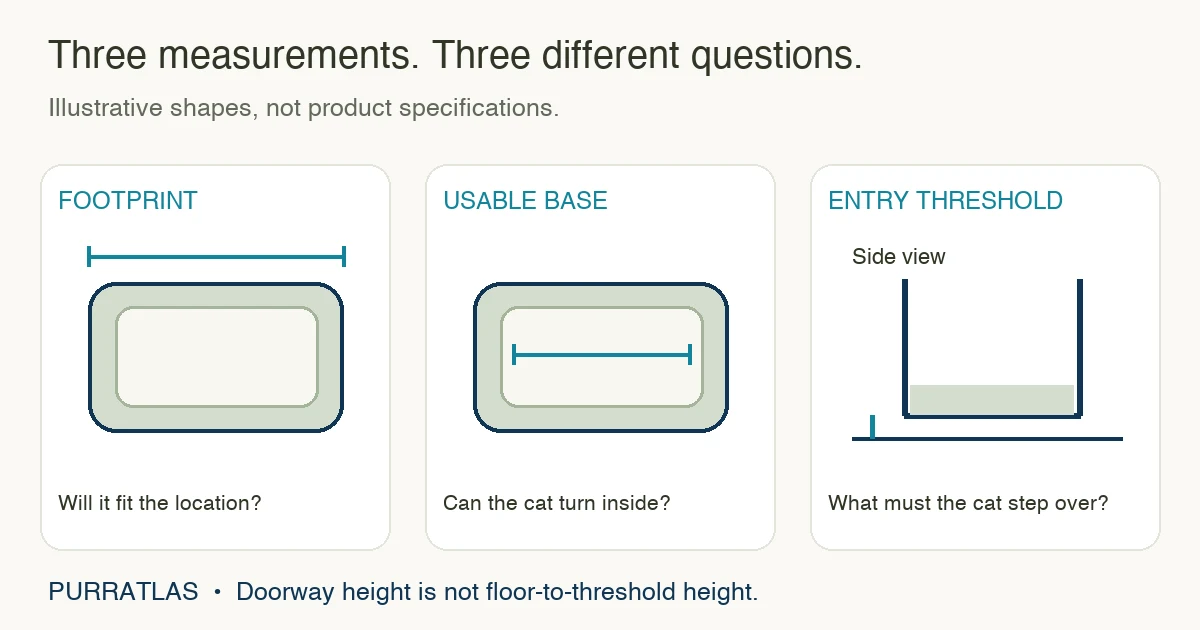
Write the measurements in three separate fields: the product's footprint, the space the cat can actually use, and the entrance. A catalogue length may include walls or a projecting rim. A curved or corner-shaped tray does not give the same floor shape as a rectangle with the same longest dimensions.
An opening's height is not the height a cat must step over. For example, a tall doorway may still sit above a raised threshold. Ask for the threshold height from the floor, the clear opening with any flap removed, and the usable base dimensions. Do not fill in missing figures from a photograph.
Measure the intended location too. Allow for the cat to approach and exit, and for you to remove a hood or rim and reach the corners with a scoop. A tray that fits under furniture may be inconvenient to inspect or remove. Make a paper outline of a candidate's stated footprint and try your cleaning movement in that location; this checks your room arrangement, not whether your cat will accept the tray.
Two official listings, compared by specifications
PurrAtlas has not physically tested these products. This is a specification-based comparison of official pages checked on 9 October 2026, not a ranking or a claim that either is suitable for your cat. Prices, stock and customer ratings are omitted.
| Question | IRIS Cat Litter Box with Scoop, SKU 500443 | Catit Airsift Regular, #50702 |
|---|---|---|
| Which dimensions are published? | 19 L × 15 W × 5.7 H inches [2]. The page does not identify these as usable internal dimensions. | 22.4 L × 18.3 H × 15.3 W inches; door opening 10.4 H × 9.6 W inches [3]. Note the different L-H-W order. Usable base dimensions are not specified. |
| What entrance information is missing? | Manufacturer describes low entry, but the reviewed text does not give a numerical threshold height [2]. | Door opening size is given, but it does not establish the floor-to-threshold height [3]. |
| What is known about materials? | Manufacturer describes plastic walls; the exact resin is not identified in the reviewed text [2]. | Manufacturer says BPA-free materials; that does not identify every component's material [3]. |
| What must be handled during cleaning? | Open tray with a removable raised rim [2]. Check how the rim comes off and where it will dry. | Hooded tray with a front section that folds back for access [3]. Check hood removal, seams and clearance in your location. |
These figures cannot prove that one has more usable floor area. They also cannot prove that the IRIS threshold is low enough for a particular cat. Ask the manufacturer for missing measurements before making an access-dependent purchase. Keep the exact SKU or model in your note: Catit's Jumbo #50695 is a different width, and should not be silently substituted for the Regular example [3].
Choose between containment and access deliberately
High sides may look appealing when litter lands on the floor, but check the entrance separately. If stepping over the current edge is difficult, adding height at the entry is not a solution merely because it contains more litter. Ask your veterinary team about access needs when mobility has changed.
A hood also changes more than appearance: it affects visibility, headroom, access to clean, and the entrance arrangement. Cats Protection advises removing a flap on a covered tray and suggests offering different tray types when preference is unclear [1]. Catit markets a front door as a product feature [3]; that feature is not evidence that your cat needs or likes a flap.
If you are replacing a tray, retain a familiar usable option while introducing the candidate. Avoid changing the box, litter and location together if you want to learn which change mattered. Observe ordinary use without placing or holding the cat inside. Record entry, turning and exit separately rather than assuming that one visit proves long-term acceptance.
Inspect cleaning access before buying extra features
Imagine an ordinary cleaning session: getting the scoop into the back corners, removing the litter, separating components, washing them according to their instructions, drying them and reassembling the box. Ask which pieces detach and whether replacement clips or rims are available. Take account of your sink, cleaning area and where components can dry.
A manufacturer may advertise odor reduction, leak prevention or an easy-clean surface. Those are manufacturer claims, not results of testing by PurrAtlas. A filter does not show whether waste has been removed; a smooth-looking photograph does not establish that every seam is easy to reach. Material labels alone do not prove compatibility with a disinfectant or dishwasher. Read the exact product's cleaning instructions.
Do not choose a litter-box cabinet solely to conceal the tray. Check its clear entrance and cleaning access with the actual box in place. In a multi-cat household, the furniture arrangement must also allow access without another cat blocking the route. Use multi-cat home planning for the wider resource layout; purchasing one larger tray does not by itself solve distribution.
Make the decision conditional when a measurement is missing
Illustrative buying situation: an older cat is hesitating at the existing entrance. A household likes the IRIS low-entry description but cannot find the threshold measurement. Its next action is to request that figure and discuss the cat's change in movement with its veterinary team, rather than ordering on the word “low.” This is an invented example, not a customer outcome.
Another illustrative household wants the Catit Regular in a narrow alcove. It has checked the stated width, but not the space needed to fold back the front or remove the hood. It first checks that cleaning clearance. Whether the cat accepts a covered tray remains a separate observation.
A useful purchase note ends with a decision and any condition: exact model; measurement basis and units; entry height still to confirm; usable space; cleaning access; return conditions; and the familiar tray you will retain during introduction. If an essential measurement remains unknown, keep the choice provisional. The goal is a usable toilet arrangement, not a feature count.