
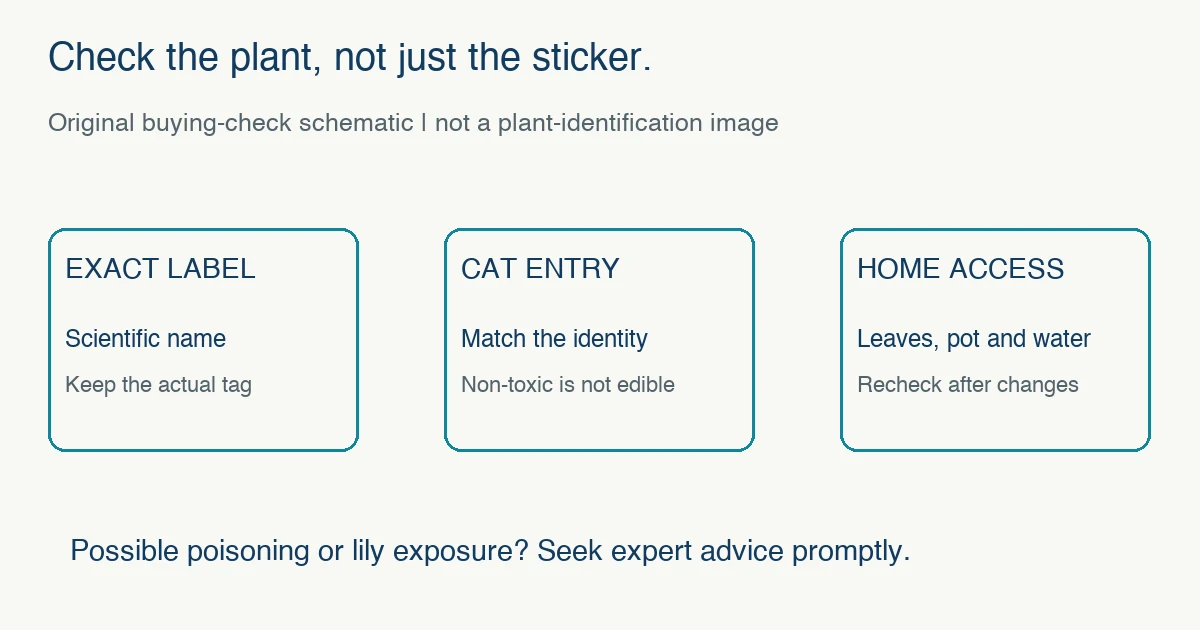
Choose by plant identity before choosing by appearance
For a home with cats, start with the scientific name on the plant label, then check the cat-specific entry in an authoritative toxicity database. A retailer's “pet friendly” sticker, a familiar common name or a matching photograph is not enough to establish that the plant in your basket is the one described in a safety list. ASPCA warns that its database is not exhaustive and that real plants can look different from its photographs [1].
If you cannot identify a plant, postpone bringing it into areas your cat can access. Ask the nursery or florist for its scientific name and keep the label. This is a purchasing decision, not an instruction to wait when exposure has already occurred: suspected poisoning needs immediate veterinary or poison-control advice.
For suspected contact with a lily, including pollen on fur or drinking its vase water, call your veterinarian or a pet poison-control service immediately. FDA explains that true lilies and daylilies can cause fatal kidney injury in cats, and that the plant's leaves, flowers, stem, pollen and vase water are hazardous [2]. Do not wait for illness to become obvious while trying to finish identifying it online.
Read “non-toxic” as a limited classification
A plant listed as non-toxic to cats is an alternative to a known toxic plant; it is not an approved snack or a promise that eating it cannot cause symptoms. ASPCA states that ingestion of any plant material can cause vomiting or gastrointestinal upset [1]. A plant's toxicity classification also does not establish the safety of a fertilizer, pesticide or other product used on it.
Use the database to narrow a purchase, then separately consider whether your cat can chew the leaves, knock over the pot or reach watering and treatment products. A plant that fits the database may still be a poor practical choice for a cat that persistently eats foliage. Removing access is more useful than repeatedly returning a chewed pot to the same spot.
Do not infer safety from the absence of a plant in a short online list. Check a full cat-specific database, and seek expert identification if the name cannot be matched. A list for dogs cannot substitute for a cat-specific check: FDA describes the severe kidney risk of true lilies and daylilies as a particular concern for cats [2].
Compare a small shortlist without treating similar names as interchangeable
The following are examples of entries actually checked in ASPCA's database. They are not a complete planting plan, a ranking or evidence that a particular shop's stock has been identified correctly. Scientific names reproduce the wording in those entries, including the Boston fern entry's spelling.
| Plant entry | Scientific name in ASPCA entry | What the check establishes |
|---|---|---|
| Parlor palm | Chamaedorea elegans | Listed as non-toxic to cats; this does not cover every plant called a palm. [3] |
| African violet | Saintpaulia spp. | Listed as non-toxic to cats; match the label to this entry rather than assuming every plant sold with “violet” in its name is covered. [4] |
| Boston fern | Nephrolepis exalta bostoniensis | Listed as non-toxic to cats; “fern” alone is not a sufficient identification. [5] |
Bring the scientific name to the store or compare it against the tag before buying. If the retailer uses a different botanical synonym or a cultivar label that you cannot confidently match, ask for clarification rather than silently treating it as equivalent. This guide has not verified botanical synonyms, individual cultivars, lighting requirements or the growing conditions of your home.
A useful purchase note records the exact label, the database entry checked, the date, the seller's treatment information if available and the proposed location. Keep a photograph of the actual plant and its tag. That helps distinguish your purchase from a visually similar plant later; it does not replace professional identification in an emergency.
Treat bouquets as a separate incoming item
A household can have carefully chosen houseplants and still receive a risky bouquet. Check every identified component, not just the main flower, and ask the florist about substitutions. A request for “cat-safe flowers” should be accompanied by a specific instruction to exclude true lilies and daylilies and to identify the remaining plants. Unidentified stems remain unidentified even when the wrapping says the arrangement is pet friendly.
FDA advises against bringing the dangerous true lilies and daylilies into a home with cats [2]. Putting them on a higher shelf is not a sound replacement for that advice: pollen and vase water are part of the exposure problem, not only a cat chewing a flower. Apply the same incoming check to gifts and visiting guests' arrangements before putting them out.
The word “lily” also needs care. FDA distinguishes true lilies and daylilies from other plants with lily in their common name, and explains that some of those other plants can cause different serious problems [2]. That distinction is not permission to keep an unidentified lily. Do not use a reassuring common name to decide that a suspected exposure can wait.
For a hypothetical gift decision, an arrangement arrives without a plant list and includes a flower described only as “lily.” The useful action is to keep the arrangement away from the cats and obtain reliable identification before displaying it. If contact, chewing, pollen transfer or drinking vase water may already have happened, switch immediately to veterinary advice instead of continuing the gift-selection process.
Check the placement and the things supplied with the plant
After the identity check, assess the actual installation. Look for routes from furniture to a shelf, trailing leaves within reach, accessible drainage water and a pot that can fall. In a multi-cat home, check each cat's routes rather than assuming that one cat ignoring a plant means all cats will do so. Do not use a hanging arrangement as a safety claim without examining how the cat could reach it and whether it is securely supported.
Keep plant treatments and their packaging separate from pet areas. Read the specific product's instructions and ask the seller what has been applied if that matters to the purchase. The plant entries above do not verify a pesticide, fertilizer, soil additive or decorative material. This page does not recommend homemade sprays or household deterrent mixtures as safe to apply around cats.
Avoid occupying a cat's useful perch or blocking a route simply to display a plant. The indoor-life guide can help assess resting places and access. If chewing seems connected with the cat's use of the room, consider what suitable activities and spaces are available through play and enrichment; do not assume that providing a toy makes a toxic plant acceptable.
Recheck access when you move furniture, replace a pot or bring in a new cat. A location that was difficult to reach yesterday can become accessible from a new chair. If a cat repeatedly chews a plant, remove access and discuss concerning behavior or symptoms with your veterinarian rather than relying on the “non-toxic” label to dismiss what you observe.
If exposure is possible, hand over facts instead of a home diagnosis
For possible poisoning, contact your veterinarian or an appropriate animal poison-control service promptly. ASPCA's plant database gives its 24-hour poison hotline as (888) 426-4435 [1]. That is a US service; outside the US, use your local veterinarian or a relevant local poison service. This guide does not verify call charges or substitute for the professional's assessment.
Have the plant's name or label, a photograph, what the cat may have touched or swallowed, the approximate time and any observed symptoms ready. Include vase water or pollen contact rather than reporting only whether a leaf was eaten. FDA recommends bringing the lily plant or a photograph to help the veterinary team identify it [2]. Follow the team's instructions about what to bring and how to transport the cat.
If you do not know the amount or species, say so. Missing information is not evidence of a small or harmless exposure. Do not delay the call until you can produce a complete record, and do not use this buying guide to choose a treatment. For a requested clinic trip, the carrier-entry guide offers handling preparation, but urgent professional instructions take priority over a gradual training session.
The intended result of a routine plant check is a clearly identified purchase with a documented cat-specific entry and a considered location. If either identity or the household setup remains uncertain, declining that purchase is a valid outcome. If exposure may already have happened, the result to pursue is timely expert advice, not a more reassuring search result.