
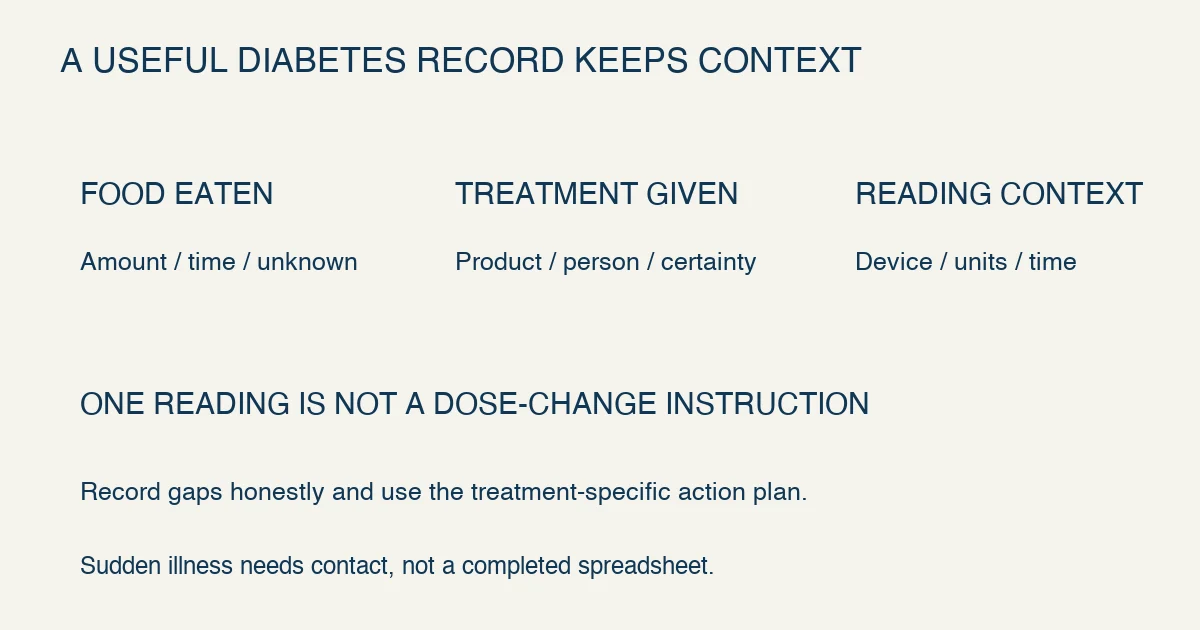
For a cat already diagnosed with diabetes, a useful home record links food intake, treatment actually given, observations and measurements requested by the veterinary team. It helps the team interpret what happened between visits. It is not an instruction to choose a dose from a number or diagnose remission at home.
If the cat becomes weak, uncoordinated, collapses, has seizures or struggles to breathe, seek urgent veterinary help. Do not spend time completing a spreadsheet first. Cornell describes potentially life-threatening low blood glucose and ketoacidosis; the response needs the cat's actual treatment plan. Never force food, fluids or fingers into the mouth of a convulsing or unconscious cat. [1]
Agree on the treatment-specific plan first
Ask the team for the exact medication, concentration, equipment, prescribed amount, timing and storage instructions. If insulin is prescribed, have the team check that the syringe or pen matches it and watch you use it. Cornell specifically warns that different insulin preparations require appropriate equipment. This page supplies no conversion between syringe markings or insulin concentrations. [1]
Get written instructions for a missed treatment, uncertain delivery, reduced appetite, vomiting and a suspected low-glucose event. Insulin and oral diabetes medicines are different treatments. An instruction for one product or another person's cat cannot safely be borrowed for your own.
FDA describes Bexacat and Senvelgo as SGLT2 inhibitors, not insulin, with specific eligibility and safety requirements. They are not a general replacement to start because injections are difficult. Cats previously or currently treated with insulin should not receive those products according to FDA's guidance. Ask the prescriber about the full history rather than switching independently. [2]
For a cat taking either of those oral products, FDA instructs owners to stop the drug and contact the veterinarian immediately if food interest falls or stops, activity decreases, vomiting or diarrhea begins, or weakness or difficulty walking develops. Serious complications may occur despite apparently stable glucose. [2] This product-specific warning does not create a blanket instruction to stop or halve insulin whenever a meal is smaller; insulin problems need the team's own instructions promptly.
Make one record that both caregivers can trust
Choose a paper sheet or shared note that everyone can access at the time of care. Use the same cat identifier and units throughout. Keep the current prescription at the top with the date the team last confirmed it; old instructions should not remain beside it as an equally current option.
For each treatment event, record the date, time, product, prescribed amount actually administered, person responsible and any uncertainty. Record completion immediately after giving it. Preparing a syringe or placing a tablet beside the food does not count as administration.
A hypothetical handover illustrates why this matters: one person writes “evening dose prepared,” then leaves. Another sees the equipment and assumes it was given. The record needs an explicit completed, not given or uncertain state. If a dose may already have been given, contact the team instead of administering another merely to make the log look complete.
Record a missed event honestly. Retrospectively filling every box without knowing what occurred creates misleading clinical evidence. This page is a record-writing guide; it does not promise that a PurrAtlas account automatically detects duplicate doses or sends medication reminders.
Describe food, water and toileting without false precision
Keep the actual food product, amount offered, amount eaten when measurable, feeding time and treats or additional food in the record. Separate appetite from quantity: approaching a bowl enthusiastically is not proof that the planned ration was eaten. A shared bowl also does not show which cat ate it.
Record changes the team asks about, such as drinking, urine production, body weight, activity or grooming. Cornell includes these in home monitoring. [1] Use consistent weighing methods and identify the date and scale. A new measurement method can create an apparent trend that does not reflect a true change.
If water is measured from a shared bowl, label it household use. Spilled water, evaporation, food moisture and another animal affect interpretation. Similarly, a larger litter clump is an observation, not a measured urine volume. “Not individually measurable” is better than assigning a precise amount to the wrong cat.
Do not restrict water to improve the appearance of the record. Ask about a workable feeding arrangement if animals share resources; the separate feeding spaces guide can help prepare those practical questions. Diet changes and weight-loss plans should be agreed with the veterinary team because they may affect treatment needs.
Keep glucose readings tied to their context
Only perform home testing that the team has taught and requested. Record the device, unit, reading, time and its relationship to food and treatment. Keep the original meter or sensor data available if possible. Do not combine mg/dL and mmol/L in one unlabeled column or silently copy a human-device result as if every meter were interchangeable.
If the team requests a curve, follow its schedule and record missed readings. One isolated value cannot reconstruct the missing hours. Cornell explains that a clinic reading can be elevated by stress, that home curves can provide useful information, and that an average such as fructosamine does not show every high and low. [1]
Ask what to do with an unexpected reading, an error message, a detached sensor or a reading that disagrees with how the cat appears. This page does not establish a threshold for automatic dose changes or a way to troubleshoot every device. Cornell explicitly cautions against changing insulin doses without veterinary discussion. [1]
A reassuring reading is not permission to ignore illness. FDA warns that serious adverse effects associated with the named oral drugs can develop even with stable blood glucose. [2] Record the clinical change and contact the team, rather than using one number as a clearance test.
Send a short account when something changes
When calling, give the medicine and latest confirmed treatment, food actually eaten, relevant readings with units, and the time the change began. Say what is uncertain. Keep vomiting, weakness or reduced activity as separate observations rather than diagnosing a cause from the pattern.
For example, “less than usual food since this morning; one confirmed treatment at the prescribed time; now quiet and vomiting” is clearer than “diabetes is worse.” The team needs to decide whether the problem relates to glucose, the medication, another illness or more than one issue. Do not wait for a complete week's log before reporting an acute change.
At scheduled review, send the date range and records in the requested form. Highlight repeated missed or uncertain treatments, feeding difficulties and measurement gaps. Ask what needs changing and when the next check is due. Record the new instructions with their date rather than editing old entries to match the new plan.
Use the vet-visit record to keep the handover concise. The goal is a truthful record the clinical team can act on, including unknowns, not a perfect-looking graph or a self-managed dose algorithm.