
Start with the exact tablet and the prescribing instructions
Before giving a cat a tablet, confirm the medicine, strength, prescribed amount, timing and method for that individual cat. Ask the veterinary team to demonstrate a method you can perform safely. Food, crushing and changing the formulation are not interchangeable shortcuts: some medicines need an intact tablet or an empty stomach [1].
If you cannot administer a prescribed dose, contact the clinic for a workable alternative rather than repeatedly forcing the cat or quietly stopping treatment. This guide helps you prepare, choose an approved method and report what happened. It supplies no dose, drug substitution or instruction to medicate a cat without veterinary direction.
Settle the questions that a pill-hiding trick cannot answer
Read the current label with the veterinary team if anything is unclear. Confirm the cat's name, the product and strength, how much to give, when to give it and how long treatment continues. FDA advises asking about the administration route, food, storage, interactions and follow-up [2]. A photograph of an old prescription is not confirmation that the current plan is unchanged.
Ask these tablet-specific questions before leaving the clinic:
- Must this tablet remain whole, or has the prescriber specifically allowed splitting or crushing this product?
- Is food required, permitted or unsuitable, and are the proposed treats compatible with this cat's diet?
- Does the method need a follow-up drink or food, and can someone show you how to provide it safely?
- What should you do if the cat spits it out, eats only part of the medicated food, vomits, or a dose is late?
- What reaction requires an immediate call, and which after-hours service should you contact?
Take the actual packaging to a demonstration. A technique that works for one tablet may not suit a different size or formulation. If handling instructions require gloves, follow them; wash your hands afterward [1]. Store the medicine as its label directs, away from children and animals.
Use food only when the veterinary team agrees to that plan
Cats Protection describes food-based methods only with veterinary approval and stresses that the cat must consume the medication rather than spit it out or leave part of the meal [3]. Cat Friendly Homes is more cautious about routinely using food, because medication can create food aversion and reduce intake [4]. Discuss that concern directly, especially for a cat already eating poorly or on a restricted diet.
If the team approves a food method for this exact medicine, clarify whether approval covers an intact tablet only or also crushing. Use the agreed food and method; do not assume approval of a treat means permission to grind the tablet into it. Observe the intended cat consuming it. In a multi-cat home, an empty shared bowl cannot confirm the right animal received the dose.
If medicated food remains, report that rather than estimate an absorbed fraction from the volume left. Do not top up with another tablet. Keep regular food acceptance under review and contact the team if attempts are interfering with eating. Separate feeding arrangements can support observation, but do not make an uncertain dose certain.
Get a demonstration before giving a tablet directly by mouth
PDSA and Cat Friendly Homes both recommend help from a veterinarian or veterinary nurse when tablets are difficult to give [1][4]. Ask for a demonstration with your cat and then show your understanding while help is available. Include positioning, gentle mouth opening, tablet placement, swallowing support and what to do if the cat resists. A pill applicator also needs instruction; purchasing one does not resolve technique or handling safety.
Prepare the tablet and any approved follow-up supplies within reach before bringing the cat over. Use a stable, non-slip surface and calm movements. If another person helps, agree their role before starting. Avoid holding the cat in the air while trying to administer the tablet [3].
Do not chase a hiding cat, escalate restraint or force repeated attempts. Cat Friendly Homes specifically advises against forcibly removing cats from hiding or interrupting eating, grooming or elimination to medicate them [4]. If the demonstrated method cannot be completed safely, stop the attempt and contact the prescribing team promptly for help meeting the treatment plan. Ask how soon the problem needs to be resolved.
After administration, watch for a spat-out tablet instead of treating the end of handling as proof of swallowing. Offer an appropriate reward the cat enjoys, consistent with its care instructions [3][4]. Breathing difficulty or another acute illness needs urgent veterinary help, not another pill attempt.
Treat an uncertain dose as information to report
FDA explains that vomiting does not reliably establish that none of a medicine was absorbed; repeating a dose can result in excessive exposure [2]. Missed-dose instructions also depend on the medicine. Follow instructions already supplied for that specific situation, or call the veterinary team. Do not invent a catch-up schedule or double the next dose.
For the call, have the label ready and report the scheduled time, actual attempt time, amount offered and observations. Distinguish “tablet found intact on the towel” from “cat ate some of the food” or “vomited after the attempt.” Include other medicines and any new signs. You do not need to determine absorption yourself before asking for help.
If too much medicine was accidentally given, contact the veterinarian immediately [2]. Keep the packaging available. Avoid adding a home remedy while trying to correct the mistake.
Keep one administration record across caregivers
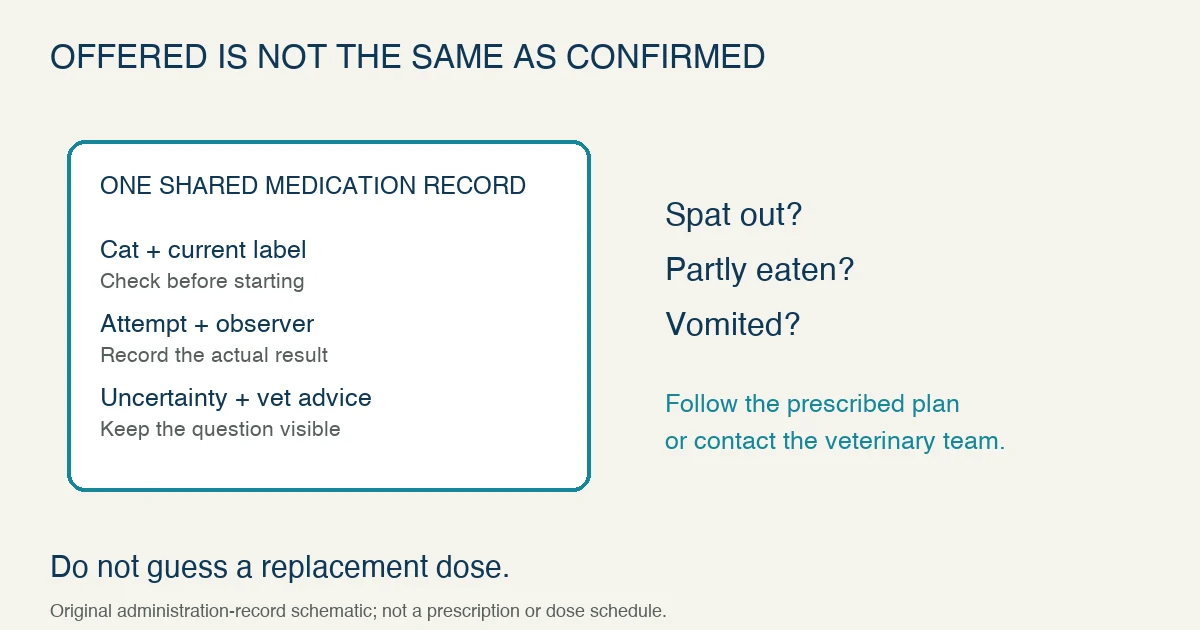
The following is an illustrative record format, not a prescription or a dosing schedule. Enter the real label instructions and the veterinary team's advice. Leave uncertainty visible.
| Record field | What belongs in it |
|---|---|
| Cat and prescription | Cat identity, medicine name and strength, current labelled instructions. |
| Planned administration | Due time and the agreed method; not a guessed substitute. |
| Observed result | Time, caregiver, amount offered and what was actually seen. |
| Unresolved event | Spat out, partly eaten, vomited or not confirmed; note the call and advice. |
Check the record before starting, and write the result immediately afterward. A reminder being dismissed does not prove administration. If two people disagree about whether a dose was given, use the prescribing team's uncertainty instructions rather than each person giving one “to be safe.”
For someone covering care while you are away, include a demonstrated method and contact arrangement in the sitter handover. If they cannot perform the required task, arrange suitable care before leaving.
Ask for a different plan when the current one is not workable
Alternative formulations or administration options may exist, but availability and suitability need the prescriber's confirmation [1][4]. A liquid is not automatically the same concentration, and a skin preparation is not automatically an equivalent replacement for an oral tablet.
Explain the specific obstacle: locating the cat, safe handling, tablet size, food refusal, swallowing uncertainty or the caregiver's ability to meet the schedule. Agree the revised written instructions and any recheck. The goal is reliable prescribed treatment with a method the household can actually carry out.