
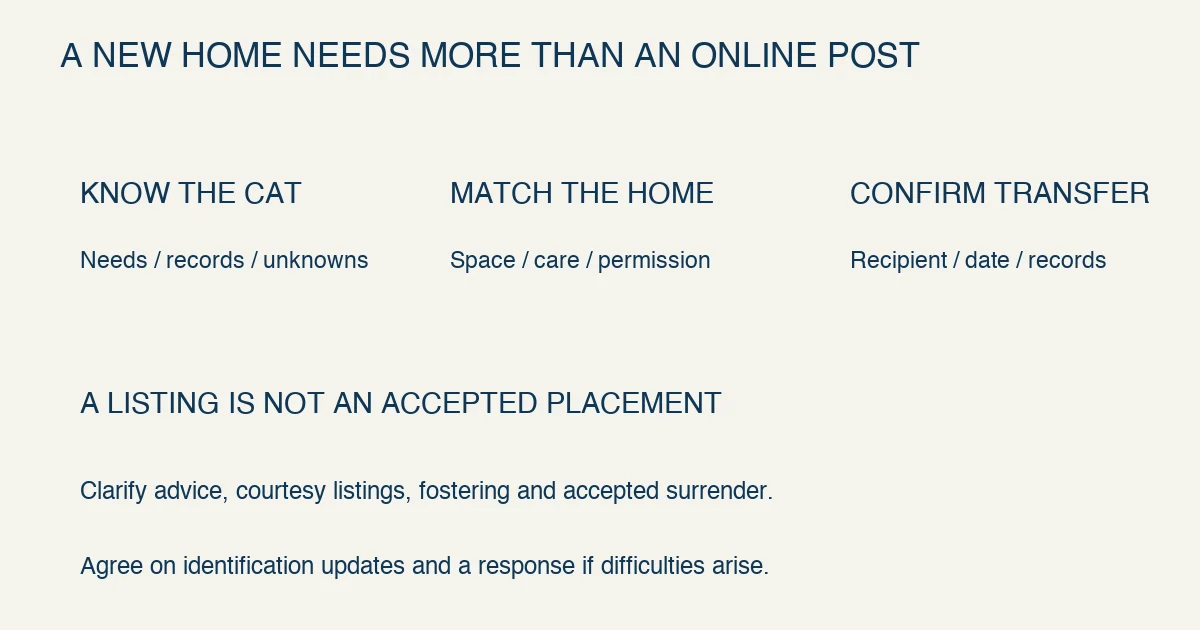
If you cannot keep your cat, a responsible rehoming plan needs two kinds of information: what this cat needs, and what the receiving household can actually provide. An online post, an interested stranger or a promise to collect the cat is not a completed placement.
This guide helps you prepare that process in the United States. PurrAtlas is not an adoption service: we do not screen applicants, verify homes or guarantee shelter space. If the cat is in immediate danger or you have an urgent housing deadline, contact a local animal-welfare organization directly and explain the situation before arranging a transfer.
Separate a temporary difficulty from a permanent change
Write down why the current arrangement cannot continue. Housing restrictions, treatment costs, your own illness, conflict between animals and a new behavior problem require different responses. A short-term gap in care may need temporary help rather than permanent adoption. Humane World for Animals describes support and rehoming options, but availability and eligibility need to be checked locally.[1]
Ask about the specific barrier. A food-assistance program will not necessarily solve a landlord restriction; a foster offer may have a time limit; a behavior consultation cannot guarantee that two cats will become compatible. If a new behavior change is driving the decision, discuss it with your veterinarian rather than assuming it is a fixed personality trait.
If your cat came from a rescue or shelter, find the original adoption agreement and contact that organization. It may specify a return process or require you to involve them before arranging another home. Do not assume every organization has the same rule or can accept a cat immediately.
Resolve ownership questions first. A found cat or a cat whose ownership is disputed is not automatically yours to rehome because it is currently staying with you. Seek guidance from the appropriate local organization before advertising a permanent transfer.
Make an honest profile that supports matching
Describe the cat you know, with current photographs and clear distinctions between facts and unknowns. Include known age, identification, veterinary records, current medication, usual food and litter, handling preferences and experience with other household members. If age or medical history is uncertain, say so.
Experience with one familiar cat does not establish that your cat will accept every cat. No experience with dogs is different from demonstrated comfort around dogs. Explain where the information comes from: living together, a brief encounter or an assumption you cannot verify.
Disclose relevant biting, scratching, escape attempts, animal conflicts or difficulty with handling, including the context where you know it. Describing a problem honestly gives the receiving household a chance to prepare. Hiding it can leave the cat facing another disrupted placement. SPCA of Northern Virginia recommends providing medical history and discussing the cat's behavior with prospective adopters.[2]
For ongoing treatment, give the actual veterinary instructions and the care tasks involved. Do not guess the prognosis, promise that medication will soon stop or invent a future treatment cost. With your veterinarian, identify what records can be shared and how a new caregiver can continue care.
Keep public listings separate from private records. A public profile does not need your home address, complete personal documents or other people's contact information. Share relevant veterinary records with serious candidates through an agreed process and obtain permission before giving someone else's contact details.
Evaluate the household before agreeing to transfer
A conversation should move beyond “Do you like cats?” Ask why this particular cat interests the applicant, who lives in the home, what other animals are there, how daily care will work and whether the housing arrangement permits the cat. SPCA of Northern Virginia's rehoming guidance includes questions about household members, pets, housing and previous experience.[2]
Use the cat's needs to make the conversation concrete:
- Where will the cat stay during the initial settling-in period, and can resident animals be separated?
- Is permission to keep the cat confirmed, including any relevant rental restrictions?
- Who will provide everyday care and arrange veterinary visits?
- Can the household manage the known medication, grooming or access needs?
- What will happen if the adopter's housing or care arrangements change?
For example, an applicant might understand a medication routine but have no way to separate the cat from a resident dog. That is a practical gap to resolve, not proof that the person is uncaring. Read the cat-and-dog introduction guide together if that situation is relevant; an introduction plan still cannot guarantee compatibility.
Arrange conversations, references and meetings with permission and attention to personal safety. The SPCA guidance recommends meeting the cat in familiar surroundings before adoption.[2] If that is unsafe or impractical, ask a reputable organization about an alternative process. You do not have to give an unknown person unrestricted access to your home to demonstrate concern for the cat.
An adoption fee, a photograph of an identity document or friendly messages do not independently establish a suitable placement. If someone pressures you to skip discussion, take the cat immediately or withhold important information, pause and seek help. No checklist eliminates every risk.
Understand what each organization is offering
A courtesy listing, advice call, foster arrangement and accepted surrender are different services. Establish what has actually been agreed, where the cat will live while a home is sought, who is responsible for daily care and what happens if the arrangement ends.
Call ahead before taking a cat to a shelter or rescue. Ask about their current process and capacity; a website or previous experience does not confirm that they can accept your cat today. Do not leave the cat outside a facility or release it outdoors because an intake arrangement has not been confirmed. Humane World for Animals explains that organizations may offer different forms of assistance, including listings and rehoming support.[1]
If using an online rehoming platform, read its current terms, fees, privacy arrangements and description of any applicant review. The sources for this guide mention platforms, but we have not independently tested their screening services. A platform name on a listing is not a verified safety guarantee.
State a real deadline plainly when asking an organization for help. A submitted form, unanswered voicemail or expression of sympathy is not an accepted intake appointment. Keep a record of whom you contacted and what they confirmed so that you can distinguish a possible option from an actual arrangement.
Prepare a complete, deliberate handover
Before collection, confirm the recipient, date, transport arrangements and records to be transferred. Clarify whether the arrangement is permanent adoption or temporary fostering. Write down the responsibilities and the agreed contact process if the placement does not work out. This page does not provide a legal contract or promise that a generic agreement will be enforceable in your location.
Send the cat's veterinary information, prescribed care instructions, usual food and litter details, and useful familiar belongings. Explain any practical issue that might otherwise surprise the new caregiver. The bringing-a-cat-home guide can help them prepare a quiet starting room and a gradual settling-in process.
For a microchipped cat, explicitly agree who will contact the registry, what information must be changed and how the update will be confirmed. A chip being present does not mean that the registry has the new caregiver's current details. See checking a cat's microchip registration for the distinction between a chip number and a usable contact record.
Use secure transport and agree where the cat will arrive. Do not make releasing the cat into a yard or meeting a resident dog at the doorstep the first handover step. Give the new caregiver the existing veterinary contact information where appropriate and make sure they have identified their own route to urgent help.
Close the process with follow-up, not assumptions
Agree on a reasonable way to exchange updates and on boundaries for future contact. A first-day photograph does not prove that every long-term need is met; hiding soon after a move does not by itself establish that the placement has failed. Discuss concerns in context and seek veterinary or qualified behavior guidance when needed rather than arranging another rapid transfer without understanding the problem.
The practical endpoint is a disclosed and understood care history, a household prepared for this cat, a deliberate handover, confirmed identification updates and an agreed response if difficulties arise. Listing views and the speed of finding a willing person do not measure those outcomes.