
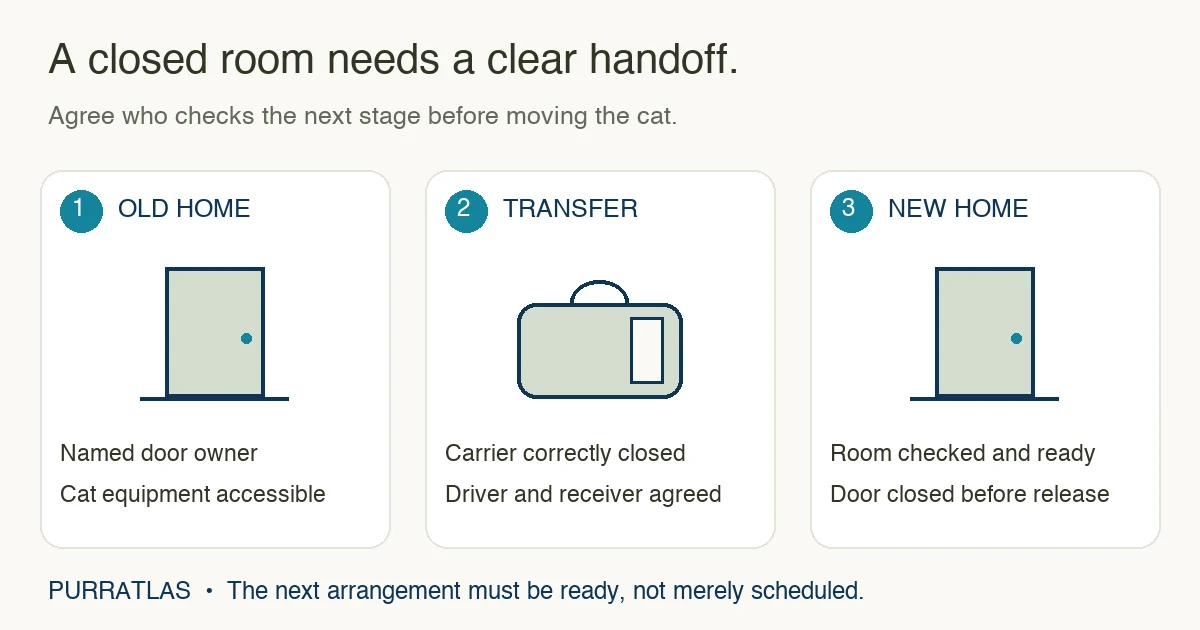
Plan the handoffs, not just the drive
Moving an established household has a particular problem: packing and unloading repeatedly open doors while the cat's familiar spaces disappear. Your plan needs to say who is responsible for the cat at each stage, where the cat will be, and what must be ready before the next transfer.
Cats Protection describes three options for moving day: staying with you, a suitable trusted caregiver, or boarding. The choice depends on the cat and the practical arrangements, rather than one option always being less stressful [1]. If you cannot reliably keep a room closed during the move, arrange another suitable care plan before movers arrive. Confirm the caregiver's requirements and ability to keep your cat securely indoors.
This page covers a household move, not international entry rules, airline approval or a medical travel plan. Discuss existing health needs, feeding around travel and any prescribed medication with your veterinary team in advance. Do not borrow another pet's sedative or invent a fasting schedule from a moving checklist.
Give the old home's cat room a real owner
A room is not protected just because a sign says “cat inside.” Choose a person to control access and tell the moving team whom to contact. Keep the room out of the packing route; do not store urgently needed tools or boxes there if people will keep retrieving them.
Blue Cross recommends a closed room during moving activity, with a notice so others know to keep it shut [2]. Prepare familiar resources before the busiest period. Check the window, door latch and any other exit before placing the cat there. A visitor who does not know the plan should not become responsible for opening that room.
Use a short handoff note with names, not “someone will check.” For example: “Alex controls the cat-room door; Sam drives; Lee confirms the destination room is ready.” These are invented roles to illustrate a communication plan. If Alex has to leave, the replacement person needs to accept the role before Alex stops monitoring access.
Do not assume cats who previously shared a house can comfortably share one small room during packing. Cats Protection advises separate resources and, for cats who do not enjoy each other's company, potentially separate rooms [1]. Ask for professional advice if your available space cannot support a workable arrangement.
Make the cat's equipment the last thing packed and the first thing available
International Cat Care describes keeping familiar items with the cat and organising the move so its room can be set up at the destination [3]. Turn that into a packing instruction: mark the cat's items clearly, keep them accessible, and agree where they will go before loading begins.
Your accessible kit should include the things needed for the planned journey and arrival, rather than disappear into an unidentified carton. Put the carrier instructions, veterinary contact details and any current care instructions where the responsible person can reach them. Keep prescribed medicine in its labelled packaging and handle storage according to its instructions.
Do not leave carrier familiarisation until the moving crew is waiting. Use carrier practice beforehand. If safe loading is already a problem and the move is close, ask your veterinary practice for help with this cat rather than chasing it through half-packed rooms. Carrier selection addresses equipment fit separately.
Check the transfer before opening the old room
The useful checkpoint is whether the next arrangement is ready, not whether the moving schedule says it is time. Before taking the carrier out of the room, confirm the carrier is correctly assembled and closed, the driver knows the destination, and someone will receive the cat there.
Cat Friendly Homes distinguishes carrier fit from vehicle restraint, including guidance that depends on crash testing [4]. Follow the exact carrier's instructions and resolve unclear vehicle installation with its manufacturer. A generic moving article or a handle that accepts a belt is not proof of crash protection. Keep the cat contained during transport; International Cat Care advises against transporting it in the removal van or car trunk and warns against leaving it in a hot car [3].
For a long trip, plan stops and care arrangements before departure. Do not open the carrier beside an open car door or in an unfamiliar outdoor area to see whether the cat wants a break. Ask your veterinary team about a suitable longer-journey plan, especially when the cat has health needs. A move involving flights or a border needs separate operator and official destination checks.
Do the destination-room check before releasing the cat
At the new home, unloading creates the same open-door problem. Blue Cross advises keeping the cat contained until a secure room is available, with familiar belongings, food, water and a litter tray [2]. Assign the destination check to a named person so the driver does not arrive expecting the movers to improvise it.
Check the actual room after furniture and boxes arrive. A window that was closed at your viewing may now be open; a door may be held by a cable; a cupboard may contain cleaning products. Confirm the latch works, remove accessible hazards, and make sure essential resources are usable rather than blocked by cartons. The room should not become the next temporary storage area.
Once that space is ready and the door is closed, allow the cat to leave the carrier into it. Keep access controlled while deliveries continue. If the intended room cannot be made ready, use your agreed backup care arrangement rather than releasing the cat into active unloading. Do not leave a cat waiting unattended in a vehicle while the room is prepared.
Use observations to decide what happens after unloading
Blue Cross describes gradual room-by-room introductions, while Cats Protection emphasises the individual cat's readiness and continued access to a retreat [1,2]. Do not promise that every cat will be exploring normally by the evening. An unpacked house and a cat ready to explore are separate conditions.
Write down observable facts: food offered and eaten, litter use you actually saw, where the cat rested, and which spaces it voluntarily visited. In a multi-cat home, note when identity is uncertain. “Food disappeared from the bowl” is different from “this cat ate.” A concern about appetite, movement, toileting or behaviour belongs in a conversation with your veterinary team, not an automatic assumption that moving stress explains it.
Review access routes again as boxes are removed and furniture moves. If the new home is smaller, check separate resources and routes rather than simply placing all bowls and trays together for convenience. Keep familiar routines practical and consistent; do not force exploration or pull the cat out of hiding to meet visitors.
Close the administrative gaps as well as the doors
Cats Protection recommends updating the microchip registration, arranging veterinary records with a new practice where necessary, and notifying the insurer of the address change [1]. Record who will do each task and whether it is confirmed. Buying a carrier or adding an address to a household note does not update a registration database.
If you move nearby, International Cat Care warns that familiar routes can lead a cat back toward the old home [3]. Arrange a contact with the new occupants where possible so a sighting can be reported. That is a contingency, not permission to release the cat early.
Do not use a calendar date as automatic clearance for outdoor access. The organisations' published settling periods differ, and the new area, cat and household arrangement matter. Review outdoor access separately with appropriate advice; a secured indoor environment remains necessary during moving activity. This guide does not establish a universal safe day for letting a cat out.
Finish your moving note with the next real responsibility: who checks the cat tonight, who handles a veterinary concern, and who verifies the outstanding address changes. A clear handoff remains useful after the van has gone.