
Pause the reunion if there is tension
If one cat hisses, blocks, chases or reacts fearfully when another returns from a veterinary visit, give them separate safe spaces rather than making them stay together. Cats Protection explains that an absence can change scent recognition; the FelineVMA also notes that unfamiliar smells or a medical device can affect the reunion [1][2]. Those are possible contributors, not a diagnosis of the reason in your household.
Prepare the separation before opening the carrier into a shared hallway. Let the returning cat settle in a secure, comfortable room where the other cat cannot enter. A carrier is for transport and the immediate handover, not prolonged confinement while the cats “work it out.”
Follow the returning cat's discharge instructions. A cat recovering from a procedure may need a different environment or access restriction from a cat returning after a routine examination. Confirm that arrangement with the clinic. This page addresses social contact at home; it does not replace individual post-operative, feeding, pain-management or isolation instructions.
Prepare both sides of the closed door
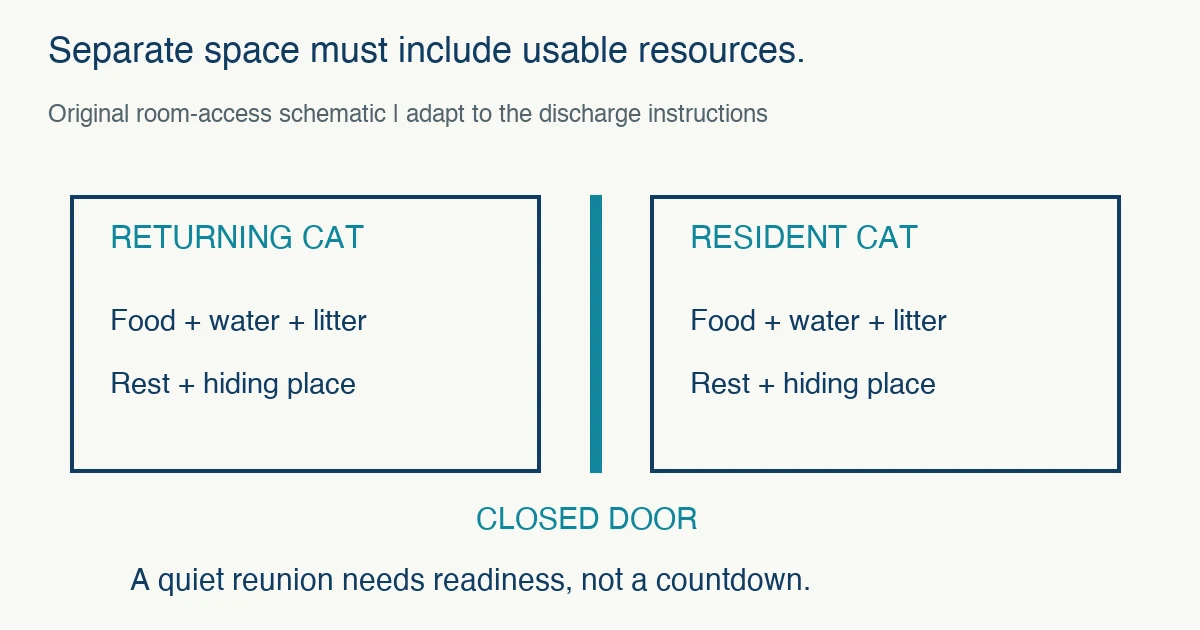
Each cat needs access to its own usable food, water, litter, resting place and hiding opportunity. Cats Protection recommends separate areas with essential resources when cats are not getting along [1]. Do not create a “quiet room” that leaves one cat needing to pass the other to reach its only litter box.
Choose a room appropriate to the returning cat's current condition. Ask the clinic about steps, jumping, bedding and monitoring if there are recovery restrictions. An area being familiar does not establish that it is suitable after a procedure. A garage mentioned in a source is not a universal waiting-room recommendation: assess temperature, escape risks, chemicals and the cat's needs rather than relying on the room name.
Make the household handover explicit. Everyone should know which door stays closed, where the other cat will be and who is checking each animal. A delivery, visitor or child opening the separation door can undo an otherwise workable arrangement.
Observe both cats. If the resident cat waits tensely at the door or blocks nearby resources, simply moving the returning cat into a bedroom has not resolved that cat's needs. Adjust the separate arrangement so neither cat has to compete at the boundary. See multi-cat home resources for the wider access map.
Do not handle an escalating encounter with your bare hands
If the cats are already reacting to one another, avoid reaching between them or lifting an agitated cat into close contact with your body. FelineVMA's guidance on tension after a frightening event explains that frustration can be redirected at a nearby person or animal [3]. Punishing hissing does not establish that the cat now feels safe.
That guidance describes using a large towel, pillow or cardboard as a visual barrier to interrupt contact safely [3]. It is a way to create separation, not a reason to strike, wrap or corner a fighting cat. Keep an exit route for yourself and do not attempt a manoeuvre you cannot perform safely. If you cannot separate them safely, contact the veterinary team for immediate guidance.
Once separated, do not repeatedly open the door to check whether they have “got over it.” Allow the cats to settle and observe their normal behaviour in their own spaces. If either cat was injured, has a concerning change or the returning cat's recovery seems abnormal, contact the clinic instead of treating everything as a scent problem.
Introduce familiar scent without forcing interaction
Cats Protection describes allowing a returning cat to pick up home smells, then using scent exchange and gradual reintroduction [1]. FelineVMA's return guidance also uses a clean towel and a separate-room arrangement before face-to-face contact [2]. The aim is a tolerable introduction to scent, not forcibly making both cats smell identical.
You can offer familiar bedding or a clean cloth carrying the other cat's scent in a place where the cat can choose to investigate. Only collect scent through handling the cat accepts; do not pursue a frightened cat with a towel or rub near a wound, bandage or medical device. Confirm any handling restrictions with the clinic.
Watch the response to the scent itself. A cat remaining tense, avoiding the area or reacting negatively is not ready merely because it has sniffed the cloth once. FelineVMA's guidance says not to progress to direct contact when there is tension with the scent or the introduction seems unlikely to go well [2].
Do not bathe the returning cat or apply perfume to disguise veterinary smells. This page has not established a safe product or a medical reason for that. A pheromone product may be discussed with your team, but it does not remove the need for separate resources, observation and a gradual plan.
Decide by behaviour and the recovery plan, not a countdown
Before allowing contact, check two separate conditions: both cats are settled with the staged introduction, and the returning cat's clinical instructions permit it. Completion of a waiting period answers neither question. FelineVMA's travel guidance explicitly places contact after a procedure under veterinary advice and advises more separation if the cats react negatively [4].
If brief contact is appropriate, supervise it and keep a workable way to separate the cats. Do not place them nose to nose, shut them into a small shared space or make them compete over a single treat. If tension returns, go back to separation rather than waiting for a fight to confirm a problem.
A hypothetical log might say: “Resident cat hissed at the carrier; cats settled in separate rooms with their own resources; resident avoided the scent cloth; no shared access attempted.” That records why the next stage was postponed. “Separated for six hours” alone would not show readiness.
Repeated tension may need a full gradual reintroduction with professional help. The FelineVMA recommends contacting a veterinarian if tension persists after a night of separation, or sooner when you feel unsure or overwhelmed [3]. This is not a required waiting time before calling. Seek help earlier when safety, access to resources or recovery is in doubt.
Tell the clinic what happened and plan the next return
Report which cat did what, where it happened, when the veterinary visit ended and whether there are discharge restrictions or medical devices. Avoid saying “they do not recognise each other” as an established cause; describe the observed hissing, avoidance, blocking or chasing instead. Your veterinarian can consider health as well as behaviour and advise whether a qualified behaviour professional is needed.
For the next visit, arrange the separate room and home access before leaving. Note which transfer route avoided direct contact and which resources each cat actually used. Share that information when preparing the appointment.
The aim is comfortable, safe access for both cats. They do not have to demonstrate grooming or sleeping together to prove that the return has succeeded. Calm coexistence, normal use of resources and a clinically appropriate recovery arrangement are more useful observations than forcing a visible reunion for the household.