
Choose a puzzle your cat can actually use
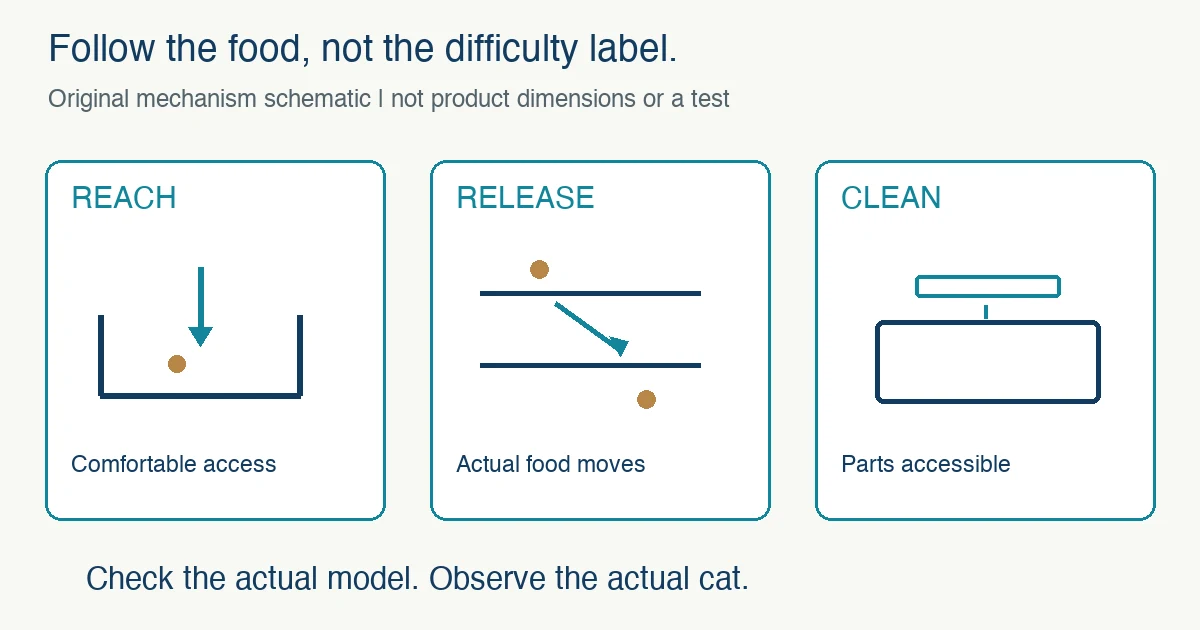
A food puzzle is useful when your cat can obtain the intended food comfortably and you can clean the device properly. A complicated mechanism, a large capacity or a “slow feeder” label does not establish any of those things. Decide whether you want a small enrichment activity or a device for part of a meal before choosing a design.
BC SPCA advises offering easy access at first, retaining a normal bowl as a choice and observing whether the activity becomes frustrating [1]. That makes reliable access to food the starting point. Do not buy a harder puzzle to solve reduced appetite, vomiting or another new health concern; discuss the concern with your veterinary team. A puzzle is not a diagnostic or treatment tool.
This is a specification-based comparison of two manufacturer-documented examples, not a hands-on review or a ranking. No stability, durability, food-contact or health-effect tests were performed by PurrAtlas. The examples illustrate questions to ask about any model, including one you already own.
Match the mechanism to the cat and the room
A stationary cup design asks the cat to reach in and lift food out. Check the position of the food, the easiest available cup, whether the cat can withdraw its paw freely and whether it needs to adopt an awkward stance. Product height alone does not describe usable reach. A claim that cups fit most paws is not a measurement of your cat's comfortable access.
A tiered design adds a different task: food needs to travel through openings before reaching a collection tray. Ask whether the easiest setting releases the actual food you use, whether pieces lodge between levels and whether every food-contact surface is accessible for cleaning. Extra settings matter only if you can identify, change and reassemble them correctly.
A rolling design, if that is what you are considering, also needs usable floor space. Before purchase, ask about opening size and adjustment, closure security and how you recover food and the object from beneath furniture. We have not verified a rolling model in this comparison; movement is a selection consideration, not a recommendation for a particular product.
Consider the feeding place alongside the mechanism. Other cats may take released pieces or block access even when there is plenty of food inside. A shared puzzle does not tell you which cat ate. For separate diets or closely monitored intake, first arrange separate feeding spaces; do not let a new toy undo that arrangement.
Two documented examples, with limits to their specifications
The following dimensions come from Catit's global product pages. They are manufacturer-listed overall measurements, not measurements of usable paw clearance or food capacity [2][3]. Confirm the model and the delivered version with the seller before relying on them for a tight space.
| Specification | Senses Digger #42985 | Senses Food Tree #43151 |
|---|---|---|
| Global listed size | 37 × 37 × 11 cm, width × length × height | 37.5 × 37.5 × 33.5 cm, width × depth × height |
| Food described by manufacturer | Dry food or treats | Dry food or treats |
| Way of reaching food | Five removable cups: three short/narrow and two long/wide | Openings around a tiered structure, with food falling to a collection tray |
| Adjustment described | Choose which cups contain food; the front basin can provide easier access | Inner disc has three opening settings |
| Detail still requiring clarification | Actual usable cup opening and comfortable reach for your cat | The same page describes four levels in its overview and three tiers in its specifications |
For the Digger, Catit lists three cups as 4.2 × 6.3 cm and two as 5.3 × 8.8 cm, labelled width × length [2]. Those numbers do not establish internal opening diameter, depth or a safe paw-size cutoff. Ask for the relevant internal measurements rather than turning an external dimension into a fit guarantee.
The Food Tree's inconsistent level descriptions are not resolved here by guessing whether the tray is counted. Request a current diagram for model #43151 if the number and arrangement of levels affects your decision [3]. Its three disc settings are a separate specification; they should not be confused with the number of tiers.
Both pages describe BPA-free materials [2][3]. That is a manufacturer statement, not a complete material list, independent certification or proof that every washing method is suitable. Similarly, statements about resisting tipping or slowing eating are not PurrAtlas test results. Choose on documented features and an attended trial, rather than assuming a guaranteed outcome.
Check the actual food before filling the device
The two examples above are described for dry food or treats. Their documentation does not establish suitability for wet food, refrigerated portions or liquid treats [2][3]. If you need a wet-food activity, select a model whose own instructions explicitly cover that use and its cleaning requirements. Do not adapt a dry-food tower on the assumption that any food will work.
For dry food, ask whether the manufacturer specifies allowable piece dimensions. We did not find a validated kibble-size range in the cited global pages. Different shapes may move differently through the same opening. An empty mechanism that turns freely does not prove it will release the actual food, and food falling into a tray does not prove the cat has eaten it.
Set aside the trial amount from the cat's existing planned allowance. Record food offered in the puzzle and food offered elsewhere so that enrichment does not become an uncounted extra supply. BC SPCA specifically warns about the total when bowl and puzzle are both used [1]. If the diet is prescribed, confirm that the proposed food and feeding arrangement fit that plan; this page does not change the ration or substitute treats for a complete diet.
Make cleaning a purchase question
Look at the disassembly instructions before paying. Can you remove the food-contact parts, reach their undersides, inspect them for retained food and put everything back securely? Ask about approved washing methods, drying, dishwasher compatibility, replacement components and what damage requires withdrawal. An “easy to clean” description does not answer those questions.
Catit's Digger product page says the cups and base disassemble and have smooth, rounded edges [2]. The linked one-page Digger manual shows fitting the base and cups into position [4]. It does not provide dishwasher settings, disinfectant instructions or a cleaning interval. We therefore do not claim any of those are approved. The Food Tree page says the top cover is removable for cleaning, but that alone does not demonstrate access to every internal surface [3].
Follow the current instructions for the actual model and contact the manufacturer when they are incomplete. After cleaning, check that parts are dry as required, correctly seated and intact before adding food. Keep the food itself under its own storage instructions; a puzzle is not a storage container with a verified shelf life.
Use the first session to decide whether to keep it
Begin with the easiest available access while you are present. Make some food readily obtainable so the cat can discover the connection without having to solve every part of the mechanism. BC SPCA suggests easy settings and showing how food emerges, while keeping ordinary feeding available [1]. Do not skip meals or withhold the normal bowl to force success.
Observe the whole task: approaching, manipulating, obtaining food and actually eating. A cat that looks at a full feeder has not demonstrated access. A cat that scatters pieces may need a different setup; a second cat collecting those pieces changes the feeding record. Check for sliding, insecure parts, trapped food and an uncomfortable posture, rather than treating a long session as automatically better enrichment.
For a hypothetical trial, you might record: “Easiest setting; several pieces visible in the front tray; cat ate from the tray but did not reach into the cups.” That supports keeping the easy access or trying another mechanism. It does not show that the cat needs deeper cups, has a behavioural disorder or consumed the whole amount placed inside.
BC SPCA recommends increasing difficulty only as the cat becomes proficient without signs of stress such as increased vocalising or restlessness [1]. There is no deadline for progressing to the hardest setting. Pause if access is unreliable, the cat appears distressed or components are damaged; retain a usable feeding arrangement while you resolve the issue. Some cats may use a puzzle only occasionally, which is still a valid outcome.
For broader activity choices, see play and enrichment. If the real problem is feeding when nobody is home, compare the different task in choosing an automatic feeder. Neither device removes the need to verify that the intended cat can obtain and eat its food.