
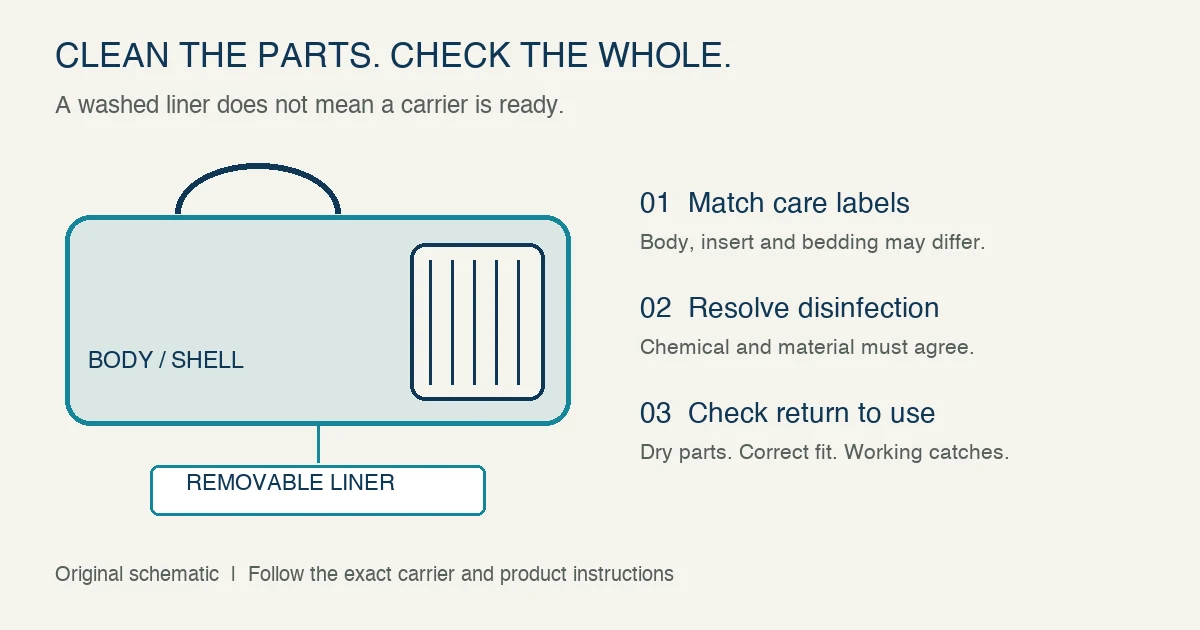
Decide what needs cleaning before choosing a product
Start by identifying the carrier's model and the parts that need attention: the shell or fabric body, removable bedding, any structural insert, and fittings such as doors or a wheeled base. Read the carrier's instructions and each removable item's care label. CDC puts manufacturer instructions first when cleaning pet supplies [1]. A washable blanket inside a carrier does not establish that the whole carrier can go into a washing machine.
For routine dirt, cleaning and disinfection are different tasks. CDC describes cleaning as removing dirt and germs with soap or detergent, and disinfection as using chemicals to kill germs. Cleaning is usually sufficient for most pet items; illness, urine or feces and vulnerable household members can make additional disinfection relevant [1]. Ask your veterinary team for an appropriate plan after a known infectious illness rather than assume a general household method covers every pathogen.
Keep the cat elsewhere during cleaning. If a clinic trip is due before the carrier will be ready, arrange a suitable clean alternative or contact the clinic for help. Do not put the cat into wet fabric or a surface with active cleaning chemicals simply because departure time has arrived.
Separate the parts and preserve the assembly information
Take out bedding and remove loose hair and debris before washing. Follow the model's instructions for opening or separating the carrier, and keep small fittings together. A photograph of the assembled carrier and a note of which fastener belongs where can help you restore it correctly. Do not force a panel apart or remove a structural insert just because it looks removable.
Inspect the areas where contamination actually went: beneath a liner, inside seams, along the door edge or into a gutter. Covering a soiled area with a fresh towel does not clean what is underneath. If the carrier has an absorbent insert you cannot access or a surface the allowed method cannot clean adequately, contact the manufacturer about cleaning or replacement before reuse.
For a hypothetical accident, a cat urinates on the towel and some liquid reaches the floor beneath it. The towel and floor need separate attention. Washing the towel is not the end of the task; check where liquid travelled, clean the permitted surfaces and determine whether anything else remains damp or soiled.
Match the method to the actual carrier
These two examples illustrate different limits in manufacturer guidance, not a product ranking or an infection-control endorsement. This guide has not tested either cleaning method.
| Reviewed source | What its instructions support | What they do not establish |
|---|---|---|
| Catit Cabrio manual, models 41370, 41371 and 41372 | Page 6 specifies a non-abrasive cloth and cleanser. [2] | It does not specify dishwasher or machine-washing approval, disinfectant compatibility or a pathogen-kill result. |
| Katziela carrier-cleaning guide | Its soft-carrier section recommends removing bedding, clearing debris, spot-cleaning without saturating the fabric and complete air drying. [3] | It is not proof that every soft carrier or internal board tolerates immersion or machine washing. |
For a hard carrier, follow its approved cleaning instructions and reach the corners and fittings without scratching the surface. For a fabric carrier, determine whether the body is spot-clean only and whether the liner and insert have separate restrictions. CDC's general guidance for soft pet items does not override a carrier's specific care label [1].
Katziela says to confirm that bedding is machine-washable before laundering it [3]. Follow the bedding's own cycle, temperature and drying instructions. Do not assume the foam or board inside a removable pad has the same washing allowance as its cover. If the label is missing, obtain clarification instead of treating fabric construction as permission to machine wash.
Choose a cleaning area suited to the job and the waste involved. CDC recommends a dedicated wash tub or a laundry sink or bathtub for pet items other than bowls and toys, with cleaning and disinfection of the area afterward [1]. Keep food and people's items clear of the work. Wash your hands after handling the carrier or waste, see the cat-and-child hygiene section, which cites CDC.
If disinfection is needed, check the chemical and the material
A disinfection plan must be appropriate for both the reason for using it and the carrier. Follow the product label's preparation, contact time, safe handling and return-to-use instructions. Keep pets away while working. CDC warns against mixing bleach with other cleaners and specifically advises cat households not to use disinfectants whose ingredient list contains phenol, including longer ingredient names containing that word [1].
Do not select a disinfectant by smell or by a “natural” label. A pleasant scent does not show that the surface is clean, and odor removal is not a pathogen-kill claim. Confirm compatibility with the carrier's materials before application. If the required disinfection method is incompatible with a carrier part, ask the manufacturer and veterinary team whether that part should be replaced or the carrier set aside.
Katziela's general guide advises against bleach for its bags and refers to vinegar in a sanitizing FAQ [3]. CDC states that evidence is insufficient to rely on vinegar as a general cleaning or disinfection method and that it does not kill all germs [1]. This page therefore does not present vinegar, a deodorizer or an enzymatic odor cleaner as a substitute for a required disinfectant. The manufacturer's material restriction and the infection-control requirement both need resolving; one does not cancel the other.
This guide does not provide a universal bleach dilution or recommend a specific product as safe for every cat carrier. Chemical concentration, intended use, contact time, rinsing and material restrictions must come from the actual applicable instructions. Following a general recipe while skipping a label requirement is not a completed disinfection process.
Dry, reassemble and check before putting the cat inside
Complete the instructed rinse or removal step and allow the carrier and bedding to dry as their care instructions require. Inspect beneath padding, around seams and in recesses; a dry exterior is not proof that an insert has dried. Do not mask persistent odor with perfume. Recheck for remaining contamination or ask about replacing a part that cannot be properly cleaned.
Reassemble using the manufacturer's instructions, then check doors, zippers, catches, fasteners, handles and straps. A clean carrier with a cracked fastening or a door that will not close is not ready for transport. Seek an appropriate replacement part or carrier rather than improvise a restraint repair and assume it is reliable. The carrier-choice guide discusses access and construction considerations if replacement is needed.
Return suitable clean bedding only when the carrier is ready. Cat Friendly Homes recommends familiar bedding and leaving the carrier in a place the cat uses, so it can remain part of the home rather than appear only for clinic trips [4]. This does not mean leaving soiled material in place for its familiar smell. The carrier-entry guide covers rebuilding voluntary familiarity if the cat is hesitant.
After a routine trip, inspect the carrier and address actual soiling promptly. Store it accessible, dry and assembled or ready to assemble correctly. A useful cleaning record states the parts treated, the permitted method used, any damage found and whether the carrier is ready. “Looks cleaner” and “ready for the next trip” are separate checks.