
Plan an enclosure the cat can enter and leave voluntarily
A catio is an enclosed outdoor area intended to give a cat outdoor experiences without free roaming. A usable plan needs secure containment, a workable return route and resources the individual cat can actually use. Cats Protection emphasizes voluntary access and the ability to return indoors, and notes that a cat may never want to use the finished enclosure [1].
Decide what you want to add: a sheltered viewing place, extra climbing space or access to outdoor smells. Do not assume purchasing an enclosure solves indoor boredom or that every cat wants the same outdoor experience. Continue providing an appropriate indoor environment [1][2].
This guide is a planning and use review, not construction instructions, a structural approval or a certification that a product is escape-proof.
Check the location before choosing a kit
Walk through the proposed location with the cat kept safely indoors. Identify the opening from the home, the surrounding exposure and the access required for people. Record dimensions for the installer, but do not infer structural capacity from a tape measurement.
For a rented property, shared building, elevated balcony or work affecting a window, confirm permissions and installation requirements with the relevant owner, building manager or qualified professional. Ask who will assess anchoring, supports and the actual site conditions. A manufacturer's photograph of a window box does not establish suitability for your window or balcony.
Look at the location at different times: which areas become sunny, where rain reaches, and whether garden equipment, visitors, dogs or neighboring cats regularly appear. Plan a usable sheltered space and a return route rather than rely on the enclosure's name or a weather-resistant marketing label.
Review the boundary, including where it joins the home
Cats Protection calls for a complete enclosure that prevents the cat escaping and other animals entering [1]. Review the roof, walls, floor, joins and access doors together. A sturdy-looking wall does not establish that an adjoining window gap, tunnel connection or floor edge is contained.
Ask the supplier or installer how each part is secured, which inspections are required and what damage makes it unsuitable for use. Resolve uncertainty before the cat enters. Do not use the cat to test whether it can squeeze through a gap, and do not invent a universal mesh opening or load limit for every cat and installation.
An enclosed balcony needs a separate fall and entanglement review. Cats Protection warns about poorly secured gaps and netting entanglement and recommends supervising balcony access [2]. Keep access closed while damage, loose netting or an uncertain attachment is unresolved. Railing height or supervision alone is not a substitute for a suitable enclosure.
ASPCA warns that childproof window guards do not reliably contain cats and that falls can cause serious injury [3]. If a cat falls, seek immediate veterinary care rather than assume it is unharmed because it lands on its feet. The door and window guide covers the home's other openings.
Make the return route usable in both directions
Check the cat's route from its normal indoor resting area to the enclosure and back. Consider a threshold, narrow tunnel, locked flap or jump that may make the route difficult. A door that someone promises to open later is different from a return path available when the cat becomes frightened.
Cats Protection advises letting the cat explore of its own accord instead of placing it inside or shutting it in [1]. For the first introduction, choose quiet conditions, stay available and allow retreat. Do not lure the cat through a route you have not checked and then close its way back.
In a multi-cat household, observe whether another cat occupies the entrance or the only resting shelf. An enclosure that adds floor area may still create a contested bottleneck. Review separate resting options and indoor resources using the multi-cat home guide. Do not count a resource as usable for a cat that cannot reach it comfortably.
Choose furnishings for actual use, not a crowded photograph
Provide a resting or hiding option, appropriate viewing and scratching opportunities, and access to water. Keep indoor essentials available too [1][2]. Position furnishings so the cat can move and retreat rather than fill every corner with accessories.
Check the exact product's installation and care instructions for outdoor use. A perch suitable indoors may have different exposure or fixing requirements outside; do not assume it belongs in the enclosure. For cats with movement difficulties, discuss appropriate routes and access with the veterinary team rather than add a demanding climbing sequence.
Identify plants by their actual botanical identity before including them, using the cat-friendly plant selection guide. Review cleaning products, coatings and stored garden materials as well. A label such as natural or water-based does not by itself establish suitability for contact with cats.
Keep food handling consistent with its actual storage instructions. Use the cat food storage guide rather than leaving a bowl outside indefinitely because the catio is covered.
Recheck the enclosure during ordinary household tasks
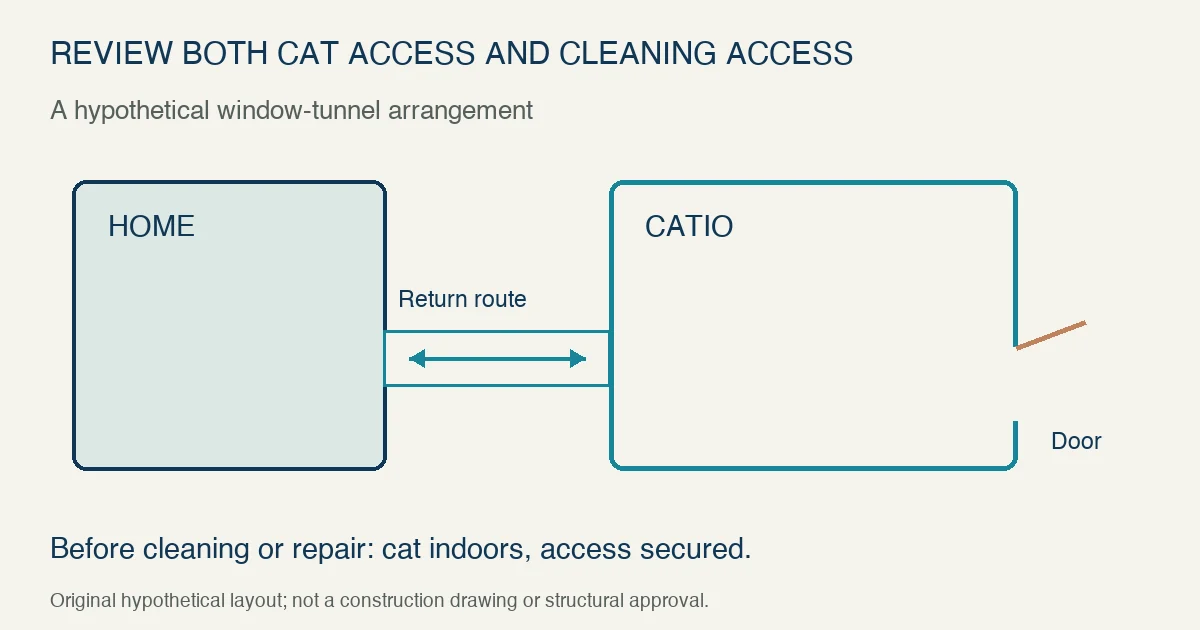
Consider a hypothetical arrangement where a cat enters through a window tunnel and a person uses a separate outside door to clean the enclosure. The tunnel may be contained while the cleaning door is open, creating an escape route. Resolve that sequence before cleaning: return the cat to the home, secure its access and complete the work before reopening the route. This example is a planning exercise, not an inspected installation.
Inspect the boundary and fittings as the supplier specifies and after weather, repairs or moving furnishings. If a fastening, mesh section or connection is loose, keep the cat out until the issue is corrected. Remember the door closing check after maintenance; inspecting the panels does not prove the latch was secured.
Watch the cat's use too. Does it settle, retreat normally or repeatedly attempt to escape? Cats Protection advises restricting balcony access if the cat becomes frustrated or eager to escape [2]. A cat avoiding the space is information to review, not a reason to carry it into the enclosure repeatedly.
Keep a practical handover for everyone who opens it
Record who opens and closes the access, what must be checked, and how the cat is kept indoors during cleaning or repair. Include the installer or supplier's instructions and whom to contact about damage. For a sitter, make this part of the care handover, including any access that must remain closed.
If a location cannot support a suitably assessed enclosure or the cat cannot use it comfortably, provide other enrichment indoors. The successful outcome is safe, chosen access that the household can maintain—not a catio bought solely to match an attractive photograph.