
If you think your cat needs to lose weight, begin with a veterinary assessment and a record of everything they currently eat. Do not start by fasting the cat, halving meals or choosing a target from a breed chart. The useful home task is to make an individual plan measurable and consistent, not to prescribe a diet from appearance alone.
If your cat stops eating or eats much less than usual, pause the weight-loss plan and contact your veterinary team promptly. The Association for Pet Obesity Prevention (APOP) warns that reduced intake and rapid weight loss can increase the risk of hepatic lipidosis. It advises same-day veterinary assessment for a cat that has eaten little or nothing for 24 hours, and earlier contact when appetite drops or the cat seems unwell. This is not permission to wait 24 hours. [2]
Establish whether weight loss is the right goal
A scale reading alone does not distinguish body fat from frame size or muscle condition. Cats Protection says ideal weight depends on the individual cat and recommends veterinary advice rather than a single standard weight. APOP asks for assessment of body condition, muscle condition, health, appetite and activity before choosing weight loss, gain or maintenance. [1][2]
Ask the veterinary team to show you how they assess your cat's condition, record the current weight and explain the intended target. A hanging belly pouch by itself is not a diagnosis of obesity; APOP advises judging the abdomen alongside ribs and waist. [2] Do not compare a long-haired cat's silhouette with a photograph and then change their calories.
Tell the team about changes in appetite, drinking, activity, grooming, medicines and mobility. Unexplained weight loss is a different problem from planned fat loss. A cat can also need a plan that accounts for pain or another medical condition rather than more strenuous play. Ask what should trigger earlier contact and when the first recheck should happen.
Audit the whole feeding day before changing it
Write down the exact foods and amounts offered, including wet and dry food, treats, toppers, food used with medication, puzzle portions and anything another person gives. Include what was left, shared or stolen if you can observe it. “One bowl” and “a few treats” are descriptions of containers or habits, not reliable intake measurements.
Keep photographs of the actual packaging and calorie information. Different recipes or package sizes can have different energy densities even when the names seem similar. Our feeding basics guide explains label and portion information; it does not determine a therapeutic ration.
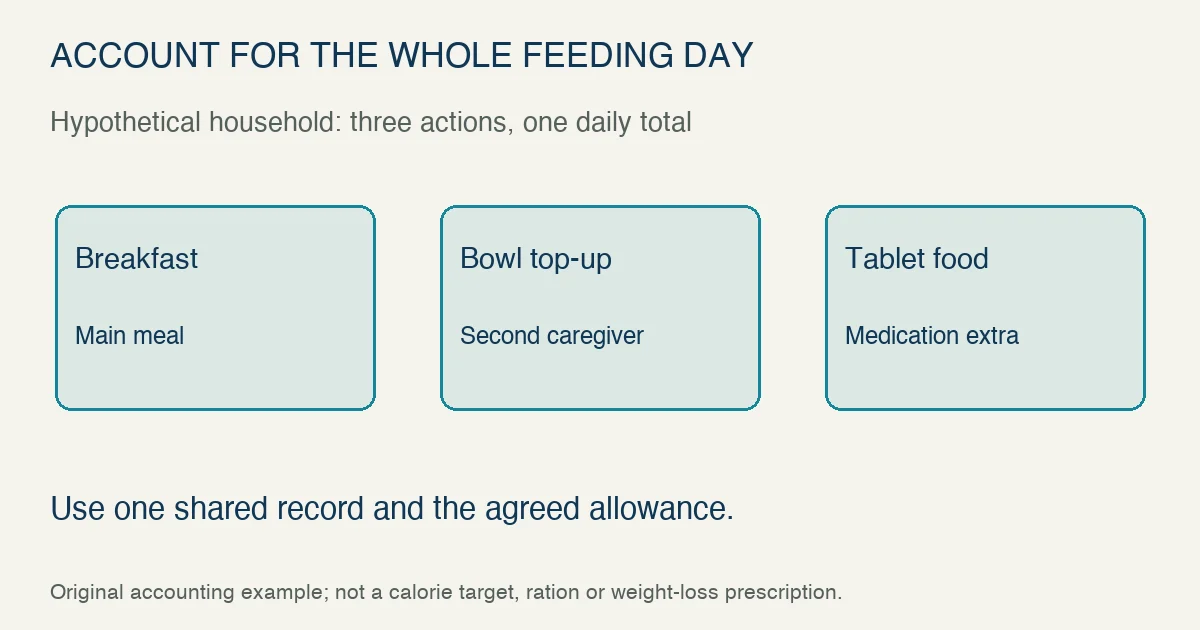
A hypothetical household has one person serve breakfast, a second person top up the bowl after seeing the cat ask, and a third use treats for a tablet. Each action appears small on its own. The missing information is the combined daily intake. The correction is a shared record and an agreed allowance, not blaming the person who happened to weigh the cat.
Do not use this audit to delay care for a cat that is unwell. It is information to bring to the appointment, and to maintain alongside the plan afterward.
Turn the prescribed allowance into a household routine
Ask for the selected food, the daily amount, the permitted extras and the measuring units in writing. Confirm whether an amount is for the whole day or each meal, whether wet and dry portions are alternatives or a combination, and whether treats come out of the total. Do not silently convert a calorie target into grams using another food's label.
APOP recommends accurately weighed food and consistent feeding across the household. [2] Use a suitable food scale for an amount expressed in grams. Tare the empty container, measure the food and label the daily allocation so another person can see what remains. A measuring cup filled differently on different days can obscure a small allowance change.
If you need a unit conversion, the food calorie converter can help with a supplied label value. It does not select a safe calorie target, guarantee weight loss or replace a veterinary nutrition plan. Confirm unfamiliar units with the team instead of guessing.
When a different food is prescribed, agree how to introduce it and what to do if the cat refuses it. The food-change guide helps record the transition; do not insist on a new food by withholding everything until the cat gives in. Cats Protection warns against starvation and drastic food reductions. [1]
Separate intake without taking another cat's food away
Shared bowls make it difficult to know who consumed a ration. Cats Protection recommends separate feeding for an overweight cat and preventing access to other cats' leftovers. APOP likewise calls for measured feeding appropriate to the individual household. [1][2]
Arrange separate eating spaces where you can see each cat eat, then manage leftovers according to each cat's plan. A cat that grazes or needs frequent access still needs a workable arrangement; simply removing all bowls may solve one cat's access problem by creating another's. Use the separate feeding spaces guide to check routes, timing and supervision.
An access-controlled feeder may help, but its label is not proof that a second cat cannot reach the food while it is open. Observe the actual arrangement, including whether one cat crowds or displaces the other. Do not force a cat through a tight opening or make essential food difficult to reach to restrict another cat. The goal is reliable individual intake, not a physical obstacle course.
Use activity to support comfort and routine
Offer brief, voluntary play suited to the cat's health, mobility and interest. APOP recommends adapting play and enrichment to age, pain and mobility. [2] Do not make a heavy or painful cat jump for every meal or chase until exhausted. Our arthritis home-care guide helps identify access changes to discuss with the veterinary team.
A food puzzle can distribute part of the agreed ration rather than add another serving. Start with a task the cat can succeed at and keep an ordinary accessible feeding option when needed. Use the food-puzzle guide to judge difficulty and actual intake. If the cat cannot obtain the food, the puzzle has become a feeding barrier.
Attention and play can be offered without another edible reward. But begging is not a measurement of calorie needs, and a change in hunger or behavior should be reported rather than dismissed as stubbornness. Ask the team how to manage persistent hunger within the selected diet and plan.
Review the trend instead of reacting to one number
Follow the agreed weighing and recheck schedule. APOP suggests weighing every 2–4 weeks during active loss and reassessing body and muscle condition at veterinary rechecks; your team's schedule takes precedence. [2] Record the date, scale, units and circumstances so a later reading can be interpreted. Do not combine pounds and kilograms or compare different scales as though they were identical.
Bring the food record alongside the weight record. If progress differs from the plan, report the actual intake, missed measurements, food changes, appetite and activity. Do not automatically cut another portion. The team may need to review health, the diet, access to other food or the measurement method.
Ask the team to define the intended pace for this cat. This page deliberately does not give a universal weekly loss target or a calorie formula: an online planning range is not an individual prescription. Sudden loss, reduced appetite or illness requires earlier contact rather than waiting for the next scheduled weigh-in.
Plan maintenance before the target is reached
Ask what changes when the veterinary team decides active weight loss is complete. Do not return to unlimited top-ups simply because the scale reached a number. Agree the maintenance food and allowance, which observations to keep and when to recheck condition.
The household record remains useful after the diet phase. It lets a sitter or family member follow the same plan and gives the team factual information if weight or appetite changes again. Your endpoint is a manageable routine and an appropriate body and muscle condition, not a promised date or before-and-after photograph.
This is an AI-assisted practical synthesis, not veterinary-reviewed advice or a therapeutic diet recommendation. The feeding example and illustration are hypothetical. PurrAtlas has not tested a weight-loss food or determined an individual calorie prescription for this page.