
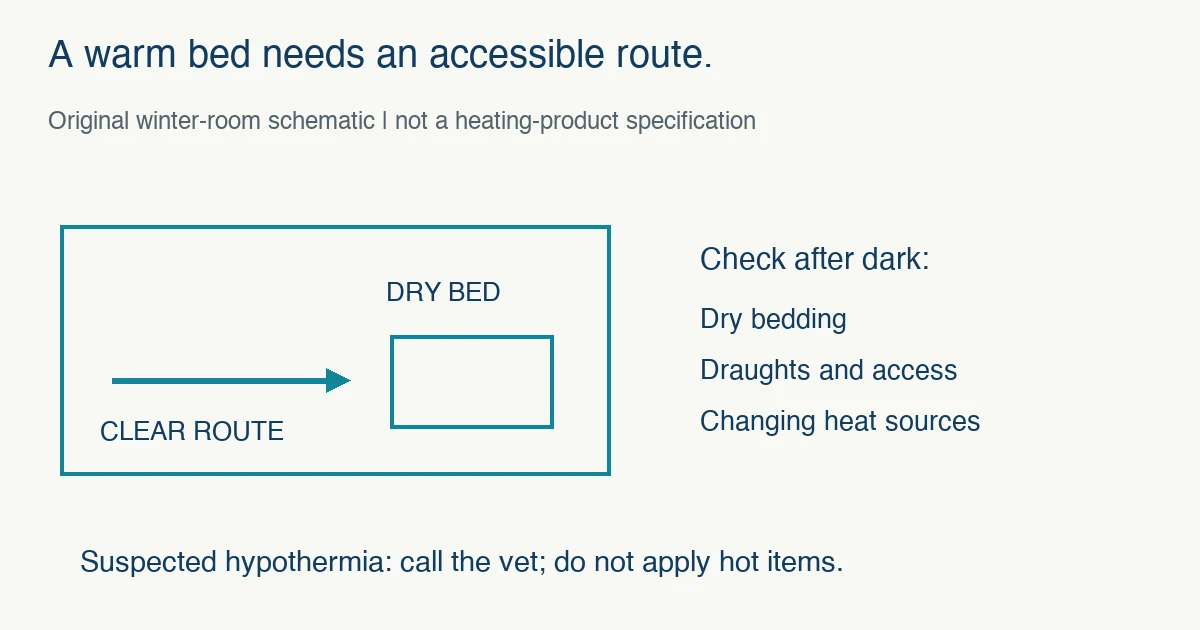
Make warmth reachable, not merely present
Prepare a dry, comfortable indoor resting place that your cat can actually reach. PDSA recommends a warm bed away from draughts and warns against leaving pets locked outside without a way to warm up [1]. For a cat already living indoors, the practical task is to check the bed's location, the room's changing conditions and access to essential resources, rather than start buying a winter wardrobe.
This is a household preparation guide. Suspected hypothermia is an emergency: call your veterinarian immediately. Signs can include shivering, confusion, poor coordination, pale gums and collapse; PDSA notes that severely cold animals may stop shivering [1]. Becoming quieter is not proof that a cold cat is recovering. While obtaining urgent instructions, bring the cat into warmth, gently towel-dry wet fur and use blankets. Do not apply hot items or force food or water; Cats Protection specifically warns against hot water, heating pads and hair dryers when responding to suspected hypothermia [2].
An electric warming product suitable for routine use is not automatically an appropriate emergency treatment. Follow professional instructions for the affected cat and transport. Do not delay the call to test a home remedy or to find a thermometer. A cat that seems better still needs the veterinary assessment advised by PDSA [1].
Inspect a winter resting place from the cat's route
A sunny window bed may be attractive in daylight and cold after sunset. Check the location at the times your cat uses it, particularly when central heating is reduced or switched off. Keep bedding dry and provide an alternative away from a draught. Cats Protection recommends warm, comfortable indoor resting places protected from draughts [2]; that advice does not prescribe one thermostat setting for every home.
Walk the route to the bed. If reaching the warm place requires a jump your cat hesitates to make, the place is not equally useful to that cat. Make food, water and toileting resources accessible without requiring the cat to remain in the coldest part of the home. For an older cat, the senior home-products guide explains how to assess actual entry heights and access; buying a thick bed does not fix an inaccessible route.
In a multi-cat household, check who uses the warmest resting place and whether another cat waits elsewhere. Offer separate choices rather than assuming the cats will share the only cosy bed. Follow the indoor-life guide when arranging routes and distributed resources.
A hypothetical evening check finds that one cat sleeps comfortably upstairs, while an older cat stays beside a draughty ground-floor door because it rarely climbs the stairs. The useful change is a reachable, dry resting option on the ground floor, followed by observing whether the cat uses it. New difficulty with stairs or jumping also belongs in a veterinary conversation; it should not be dismissed as a seasonal preference.
Keep routine heat sources separate from hazards
Screen an open fireplace and supervise the cat around a lit fire, as Cats Protection advises [2]. Check resting places beside heaters and radiators for contact hazards, unstable supports and routes that trap the cat beside the heat. A warmer spot needs to remain a choice the cat can leave.
If you are considering a heated bed or mat, check the exact model's instructions, intended indoor or outdoor use, electrical setup, cleaning restrictions and any supervision requirements. This page has not tested or certified a heating device, extension lead or radiator bed. Do not treat a product listing's word “safe” as confirmation that it suits a cat with impaired movement or the electrical arrangement in your home.
Review what happens when the heating stops. A warming device that depends on electricity cannot be your entire contingency plan during an outage. Identify a warmer available room, dry bedding and a realistic person who can check the cat if you are away. Follow local emergency directions where weather disrupts power or access; the cat evacuation guide covers planning a receiving location if staying home is no longer viable.
Do not prescribe clothes simply because the weather is colder. The dog-coat advice in PDSA's general pet guide is expressly about dogs [1]. For a hairless, unwell or otherwise vulnerable cat, ask your veterinary team what temperature management is appropriate for that individual rather than adapting a dog's winter routine.
For cats already going outdoors, check the return route
This section is for a cat that already has outdoor access; it is not a reason to start allowing an indoor cat to roam. Cats Protection advises indoor access, keeping cats in at night and checking that ice or snow has not blocked a cat flap [2]. Inspect the actual mechanism and route rather than assuming that a flap you installed last summer still opens freely.
Decide how you will confirm the cat is inside before a cold night or severe weather. If the cat returns through a door someone must open, name the person responsible and check the arrangement when that person leaves. A warm room behind a locked door cannot help a cat outside. Keep fresh water and a usable litter box indoors so the cat need not go out to reach those resources [2,3]. The litter-box guide can help you assess space and access rather than simply put a tray in an unused corner.
Check sheds and garages before closing them. PDSA also warns that cats can seek warmth under cars or near engines and recommends checking or knocking on the bonnet before starting [3]. A noise is not proof that no cat remains there; if you see or hear a cat, locate it and ensure it is clear before starting the vehicle.
A cat's coat does not provide unlimited protection. Cats Protection describes risk as depending on the individual and conditions, particularly for kittens, older, unwell and hairless cats [2]. A single weather-app number cannot certify a long outdoor stay: wind, wetness, time outside and access to shelter still matter. This page does not translate the source's UK temperature guidance into a universal “safe above this number” rule.
Respond to wet fur and possible winter chemicals differently
A cat that is wet and cold needs a dry, warm environment. PDSA identifies remaining wet in cold conditions as a hypothermia risk and recommends drying pets that become wet and cold [1]. Watch the cat's condition as well as its coat; a towel and bed are not a substitute for urgent help if weakness, confusion or other concerning signs are present.
Winter chemicals need a different response. Cats Protection identifies ethylene glycol in antifreeze as particularly dangerous, including exposure followed by grooming contaminated fur [2]. PDSA advises telling your veterinarian immediately about suspected antifreeze ingestion and not waiting for symptoms [3]. Keep packaging or the product name ready for that call. Do not assume an unidentified puddle is harmless or that wiping paws proves a possible poisoning has been resolved.
For routine salt or grit contact, PDSA advises washing affected paws [3]. Its separate discussion of dog paw butter, boots and trimming between dog pads is not a cat-care instruction. If the substance is unknown, exposure may involve chemicals or the cat is unwell, seek veterinary advice rather than improvising a cleaning product. Keep winter vehicle products contained and inaccessible and deal with spills according to their instructions.
Track a changed routine without explaining it away as winter
Check which resting places the cat actually uses, whether it can reach food and water, and whether indoor toileting remains available. An observation such as “stopped jumping onto the usual chair” is more useful than a conclusion such as “just cold.” Cats Protection recommends veterinary assessment for changes that can accompany arthritis, including hesitation to jump, altered grooming and toileting changes [2]. Those observations do not diagnose arthritis.
A simple household note can record the time, the location, whether fur or bedding was wet, a blocked door or flap, the heating status and the action taken. Keep the cat's observed behavior separate from your interpretation. The vet-visit record guide explains how to organise facts for the veterinary team.
Keep familiar activity available indoors without forcing a cat that is uncomfortable or unwell to exercise. Changes in appetite, movement or alertness deserve attention in their own right; avoid adjusting medication or assuming extra food is needed just because the season changed. The useful winter plan is one your household can carry out: dry accessible resting places, dependable indoor resources, controlled heat sources, checked return routes where relevant and a clear escalation route when the cat's condition changes.