
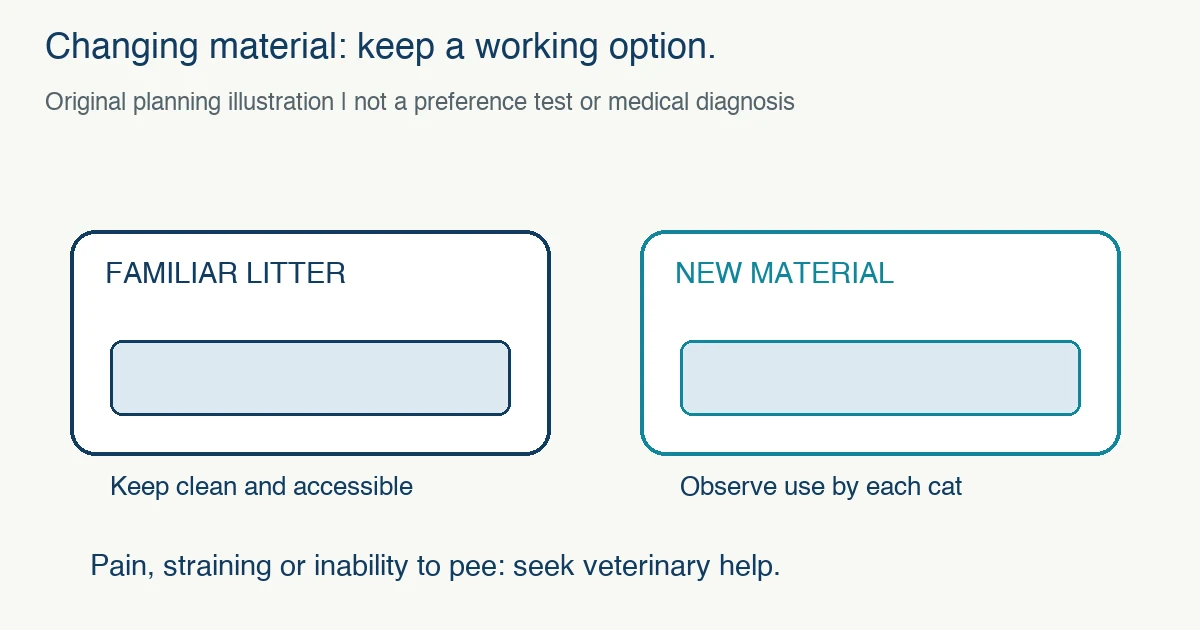
Keep a familiar toilet available while you change the litter
When changing litter type or brand, preserve a clean, accessible option your cat already uses. Introduce the replacement without simultaneously changing the box, its location and the cleaning routine. This gives the cat a usable toilet and gives you a clearer view of what changed.
RSPCA guidance describes two ways to introduce a new litter: add it gradually to the existing litter, or offer a separate tray containing the new type so the cat can choose [1]. Neither method guarantees acceptance. A different texture, fragrance or way of moving underfoot may matter more to your cat than the benefit printed on the bag.
This is a guide to a planned material change. It is not a treatment for suddenly peeing outside the box, pain or difficulty urinating. If your cat is straining, passing only small amounts or appears unable to pee, contact your veterinary team promptly. Suspected blockage requires emergency veterinary attention; do not wait for the new litter to work [3].
Decide what you are trying to improve
Write down the actual reason for switching before choosing a replacement. Is the familiar product unavailable? Is cleaning difficult? Is litter carried through the home? Has the cat stopped using a particular tray? These are different tasks. A purchase may help with maintenance, but it cannot establish the cause of changed toileting.
Record the current product, whether it is scented, its texture and how it is maintained. Keep the label or a photograph so “the old litter” refers to the exact material. If you are moving from fine granules to larger pellets, recognise that this changes the surface as well as the brand. If a product has been reformulated, the familiar name alone does not establish an identical substrate.
Cats Protection notes that many cats prefer fine, heavy, sandy litter and that some dislike perfumed litter [2]. Treat this as a starting point for a choice, rather than a rule that every cat accepts one material. For a new kitten, ask the previous caregiver what was used instead of introducing an unfamiliar substrate just because it came in a kitten starter bundle.
Do not combine a routine switch with a move to a covered box or a self-cleaning machine. If the equipment must also change, retain a familiar conventional option while assessing the separate change. See choosing a litter box for size and entry questions; the litter material does not resolve those measurements.
Choose between a separate option and a gradual mixture
A separate tray can make the choice easier to observe and avoids guessing whether unlike products can be mixed. Place it where the cat can access it safely without losing access to the established toilet. Use comparable tray conditions where practical, but recognise that different locations and box designs can affect use. This is a household observation, not a controlled preference experiment.
Keep the familiar tray clean. Making it dirty or inaccessible to encourage the new choice defeats the purpose of keeping a usable option. Do not place the cat in the new tray, hold it there or interrupt toileting. RSPCA specifically advises against disturbing a cat while it uses the tray [1].
A gradual mixture is another option described by RSPCA, which suggests introducing the change over about a week [1]. That is general guidance, not a mandatory completion date or evidence for a universal percentage schedule. Before mixing, check the handling instructions for the actual products. If mixing is prohibited, cleaning requirements conflict or you cannot confirm suitability, choose separate trays or ask the manufacturer rather than inventing a blend.
With a mixture, make a modest change and observe what happens before adding more. If the cat is avoiding the tray, advancing to the next proportion because a calendar says so is not a useful response. Preserve or restore the familiar usable option and investigate the change. Do not assume that apparent avoidance rules out illness.
A hypothetical example: a household wants to replace unscented granules with pellets to reduce material carried outside the tray. The cat continues using the familiar granules and does not use the pellet option. That observation does not prove the pellets are unsafe, nor that the cat is being difficult. It shows that the intended replacement has not yet become a reliable toilet for that cat in that setup. The household can retain the working option and reconsider the material or arrangement.
Observe actual use, not just marks in the litter
Keep a short dated record during the change. Note which cat you directly saw use which tray, whether it peed or passed stool, and any hesitation or difficulty. Record when you changed the material and what else changed nearby, such as noisy work or a door being kept closed.
A practical entry might read: “Tuesday 8:10 a.m., saw Mina pee in the familiar tray; pellet tray not observed in use; both cleaned at 8:30.” Mark it as an observation, not a conclusion about an entire day. If you only found a clump, record “clump found, cat not identified.”
Clump size is not a calibrated urine measurement. Different absorbency, depth and clumping behaviour can change what the material looks like after use. A smaller clump in a new product does not establish reduced urine output, and apparently normal litter cannot exclude disease. Share actual behaviour and timing with your veterinary team if you notice a change [3].
In a multi-cat home, one cat accepting the new litter does not establish acceptance by all of them. Keep track of direct observations where possible and preserve distributed access. A cat may avoid an otherwise acceptable tray if another cat controls the route. Review multi-cat homes rather than counting all household waste as proof that every cat has a suitable toilet.
If avoidance or accidents appear, stop treating this as a deadline
Keep the familiar option accessible, clean up according to appropriate surface and product instructions, and do not punish the cat. Cats Protection advises veterinary assessment of new toileting problems and warns against punishment [2]. The timing of a litter switch is useful history, but it does not prove that the switch caused the problem.
Check the full situation: can the cat enter comfortably, reach the tray without another animal blocking it, and use it without a nearby appliance startling it? Did someone move the box, add a liner or a strong cleaning fragrance at the same time? Record those facts. Avoid changing every variable again in an attempt to find an instant fix.
Contact your veterinary team about new or repeated elimination changes. Seek urgent guidance when there is straining, discomfort, bloody urine or only small amounts being passed; inability to pass urine or suspected obstruction is an emergency [3]. Do not decide from posture alone whether the cat is straining to pee or pass stool. Describe what you saw and any output you can actually confirm.
Use the vet-visit record to provide the material names, change date, observations and relevant household events. A diary supports the consultation; it is not a diagnosis or a reason to postpone urgent help.
Finish when the replacement is usable, not when the old bag is empty
Before withdrawing the familiar option, consider whether the replacement is being used reliably by each cat and whether its maintenance is practical for the caregiver. A single visit is limited evidence. There is no universal number of days on this page that proves acceptance or excludes a health problem.
Keep the new product's cleaning and disposal instructions. Do not assume that all clumping materials, pellets or substrates can be handled alike, or that a “flushable” marketing claim fits your plumbing or local rules. If the material makes ordinary observation or cleaning difficult, that is part of the decision too.
The successful outcome is an accessible toilet the cat uses and a maintenance routine you can sustain. Returning to the previous suitable material can be a reasonable outcome of a trial. For routine placement and cleaning beyond this change, use litter-box care; this page's purpose is to help you introduce a different substrate without removing the cat's working option or overlooking a concerning change.