
Cat grass is an optional plant to investigate and nibble, not a required part of a cat's diet. Before growing it, check what seed you have, what else is in the kit and where the finished pot will sit. A familiar green appearance is not enough to identify a plant as suitable for cats.
Texas A&M's veterinary guidance describes cat grass as grasses such as rye, barley, oats and wheat, and says a cat eating a well-balanced diet does not need it to complete that diet. It can provide environmental enrichment, but the reasons cats eat grass are not settled. [1] This page helps you arrange that optional activity; it does not prescribe grass for constipation, vomiting, hairballs or nutritional deficiencies.
Identify the seed and everything around it
Look for a clearly identified cat-grass seed or kit with actual growing instructions. Keep the label. Do not substitute unidentified lawn seed, roadside grass or a decorative grass based on its appearance. Iowa State Extension describes common oats and blends of oats, wheat and rye as cat grass; that description is not a safety approval for every ornamental plant with “grass” in its name. [2]
For a kit, check whether the growing medium, added nutrients or treatments are intended for the way it will be used. If ingredients or treatments are unclear, ask the supplier before giving the cat access. An organic or natural label alone does not answer every exposure question. Cats Protection notes that garden chemicals, including products described as green or natural, can still harm cats. [3]
Keep bags of seed, loose medium, fertilizer and gardening treatments away from the cat while setting up. Avoid adding an unverified garden treatment to a pot intended for nibbling. Growing the plant at home gives you control over its materials; it does not make unknown materials safe.
Grow one manageable pot first
Use a stable container you can inspect and clean, with no sharp broken edges. Start a modest pot rather than turning the cat's resting area into a growing tray. Follow the actual kit instructions if you are using one; different media and containers do not necessarily need the same watering routine.
For ordinary soil-grown cat grass, Iowa State Extension's method is a container of fresh potting soil, seeds distributed uniformly over the surface, a light covering of soil, watering and bright light. Its example uses a 6–8-inch-diameter container and makes the pot available when leafy growth is about 2 inches tall. Those are the extension's growing instructions, not a veterinary serving size or a requirement for every commercial kit. [2]
Grow the pot somewhere the cat cannot dig out or scatter its loose materials during germination. Give it the light and water the planting instructions require, and inspect its condition before moving it into the cat's space. Do not use a fixed daily water amount copied from a different pot: container drainage, room conditions and the growing medium affect what you actually see.
If growth is poor, check the seed instructions, light and moisture before adding more products. Do not turn a pet-accessible pot into an experiment with pesticide or fertilizer mixtures. A failed batch can be replaced; it does not need to be rescued at the cost of an uncertain exposure.
Place it for nibbling, not for access to every plant
Choose a stable, reachable surface with room for the cat to approach and leave. A bright windowsill used for growing may be a poor nibbling location if reaching it requires a difficult jump or opens access to an unsecured window. Growing location and presentation location can be different. Check door and window safety before making a window area more attractive.
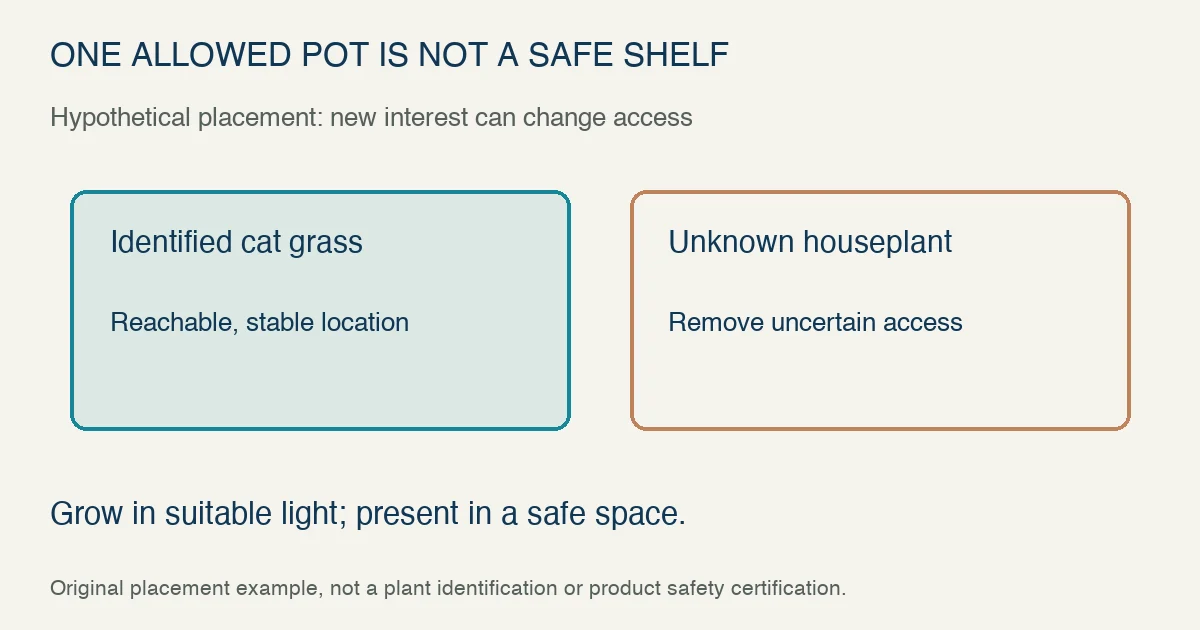
Keep the grass physically separate from other plants. Texas A&M identifies confusing cat grass with potentially toxic houseplants as an important concern and advises keeping toxic plants out of pets' reach. [1] Offering a permitted plant does not teach every cat that all other green leaves are forbidden. Remove dangerous plants rather than relying on the grass as a distraction; use our plant identification guide.
A hypothetical example: a pot beside an unidentified houseplant attracts a cat that previously ignored the shelf. The useful correction is to remove the uncertain plant and make the grass accessible elsewhere. It is not to assume the cat will select the right pot because you intended it that way.
Inspect the pot as it changes
Before offering access, and as you maintain the pot, look at the leaves, surface, container and any loose material. If there is an unexplained coating, suspected mold, a bad smell, an applied treatment or uncertainty about what has grown, remove access while you identify the problem. This guide cannot diagnose mold from a photograph or establish that an unknown patch is harmless root growth. Do not apply a fungicide and immediately return the pot to the cat.
Watch how the cat interacts. Occasional nibbling, pulling up whole clumps and persistently consuming large amounts are different observations. Texas A&M recommends discussing voracious grass eating with a veterinarian to assess whether the diet meets the cat's needs. [1] Record the actual behavior and the existing diet rather than automatically adding a supplement.
Replace a deteriorating batch instead of assuming grass will remain suitable indefinitely. Iowa State suggests starting fresh containers every few weeks for a continued supply. [2] Your cat's interest and the actual condition of the pot matter; this is not a mandatory replenishment schedule. If the cat ignores it, another enrichment activity may be a better use of space.
Do not use grass to provoke vomiting or treat hairballs
The Texas A&M article describes several explanations for grass eating as theories, including effects on fiber intake or vomiting. It does not establish a treatment protocol. [1] That distinction matters: an explanation for a possible behavior is not an instruction to make a sick cat vomit.
Do not assume repeated vomiting is beneficial because grass or hair appears in it. Remove access to the grass and discuss recurring symptoms or other changes with your veterinary team. Record when it happened, what was present and whether eating, drinking, stool or activity also changed. Do not make the cat eat more grass to clear the stomach.
For a long-haired cat, coat care addresses grooming and observations, but neither brushing nor grass replaces assessment of illness. Cat grass is also different from catnip: the names describe different materials and purposes, not interchangeable remedies.
If a plant or chemical exposure may be harmful
Contact your veterinarian immediately if you suspect a toxic plant or chemical exposure; do not wait for symptoms to prove it. Keep the package or identify the plant if you can do so safely, and report when access occurred and what you observed. Cats Protection warns that some toxins take time to act and advises against home poisoning treatment, including inducing vomiting or giving food, milk or medication without veterinary advice. [3]
This is especially relevant if the cat has reached a garden-treated area rather than the pot you prepared. Outdoor grass can be exposed to chemicals or contaminated water, according to Texas A&M. [1] Cats Protection also describes grass seeds lodging in skin, paws, eyes or ears and causing problems; that is a physical hazard distinct from a plant's toxicity. [3] A pot of young grass is not a reason to dismiss limping, swelling or persistent licking after outdoor access.
The simplest useful outcome is an identified, maintained pot your cat can choose to use without gaining access to hazardous plants. There is no need to force interest or buy a second product to make the activity necessary.
This is an AI-assisted practical synthesis, not veterinary-reviewed advice, a growing-kit test or a treatment plan. The illustration shows a hypothetical placement problem. No plant variety, growing medium or commercial formulation has been independently tested by PurrAtlas for this page.