
Catnip is an optional enrichment material, not a necessary supplement or a treatment for anxiety. If you want to try it, choose a cat product you can inspect, let your cat approach voluntarily and watch the response before offering it again. A cat that ignores it does not need a stronger exposure.
Do not treat an online claim that catnip is completely harmless as a reason to encourage eating it. ASPCA lists catnip as toxic to cats and describes possible vomiting, diarrhea, sedation or stimulation. Contact your veterinarian promptly if you suspect a harmful ingestion or your cat becomes unwell. [2]
Why “safe” is an incomplete answer
Cats Protection describes small amounts eaten as safe, while acknowledging limited research. Its explanation distinguishes sniffing from eating and describes an inherited response that not every cat has. ASPCA's plant entry instead emphasizes adverse effects. These sources do not supply a universal dose for every cat, plant preparation or commercial mixture. [1][2]
The practical decision is narrower than deciding which safety label wins: you can offer a supervised opportunity to investigate a suitable toy without making catnip a food ingredient or trying to achieve a particular behavioral effect. A catnip plant, a stuffed toy and a spray are different exposures. Read the actual product's ingredients, intended use and instructions; “contains catnip” does not establish that every other ingredient is suitable for cats.
If your cat has a medical condition, takes medication or has previously reacted badly to a plant or enrichment product, ask your veterinary team about the actual product first. This guide does not assess drug interactions or pregnancy safety.
Choose the object before the scent
For a first trial, a purpose-made catnip toy gives you an object to inspect and remove. Look for an intact surface, secure seams and no accessible loose filling, string or detachable decorations. A refillable toy also needs a closure that stays secure during the way your cat plays. Catnip does not make a damaged toy safe.
Cats Protection suggests catnip-filled toys as one possible way to encourage play, alongside many options without catnip. It advises supervising toys that can be shredded, eaten or cause entanglement and replacing worn toys. [3] Use our toy selection guide for the physical hazards rather than relying on the scent label.
Loose dried material makes access to the plant harder to control. A spray may introduce additional ingredients and a different exposure route. Neither should be treated as interchangeable with the amount enclosed in a toy. Do not improvise a homemade extract, apply it to the cat or use a human herbal product simply because its name includes catnip. This page has not tested or endorsed a formulation.
Run a voluntary, observable first trial
Choose a familiar room where your cat can move away and other animals will not compete for the object. Follow the product's instructions. Put the inspected toy within reach without pressing it against the cat's face, restraining the cat or rubbing it on their body. Watch from a little distance instead of using hands as the play target.
A responsive cat may sniff, rub, roll or chew; Cats Protection describes these reactions and also explains that some cats do not respond. [1] The objective is a comfortable opportunity to investigate, not the largest possible reaction. If the cat leaves, let them leave. If they ignore it, put it away rather than repeatedly presenting it or increasing exposure to “make it work.”
If the cat becomes very rough, guards the object, directs play toward you or another animal, end the session without grabbing at an excited cat. Allow space, then retrieve the object when you can do so safely. Sudden new aggression also deserves a veterinary check rather than being explained away as a funny catnip response; Cats Protection recommends assessment for new adult play aggression. [3]
Afterward, check the toy again for tears and missing filling. Clean up accessible loose material and store the product according to its label, out of pets' and children's reach. Record which product was used and what actually happened. Those details matter more than calling the cat “high” or “relaxed.”
Decide whether to repeat, change the activity or stop
Repeat only if the cat appeared comfortable and the object remains suitable. Let the cat return to their usual behavior first and follow the product instructions; there is no universal frequency or gram amount established by the sources used here. Cats Protection describes a temporary response and a period of reduced responsiveness afterward. Those approximate timings are not a dosing schedule. [1]
A cat that becomes more animated has not necessarily become less anxious. Do not try catnip for the first time inside a carrier just before a veterinary appointment or while introducing unfamiliar cats. It adds a new variable when you need predictable, carefully managed conditions. Use carrier familiarization or the existing introduction plan for the actual task.
No response is a valid outcome. Try a different movement, texture or play opportunity from play and enrichment instead of escalating catnip. Cats Protection describes stalking, chasing and catching games without requiring a scented toy. [3] A previously playful cat who stops engaging generally, or shows other changes, needs attention to the wider pattern, not a stronger herb.
In a multi-cat home, watch access as well as excitement
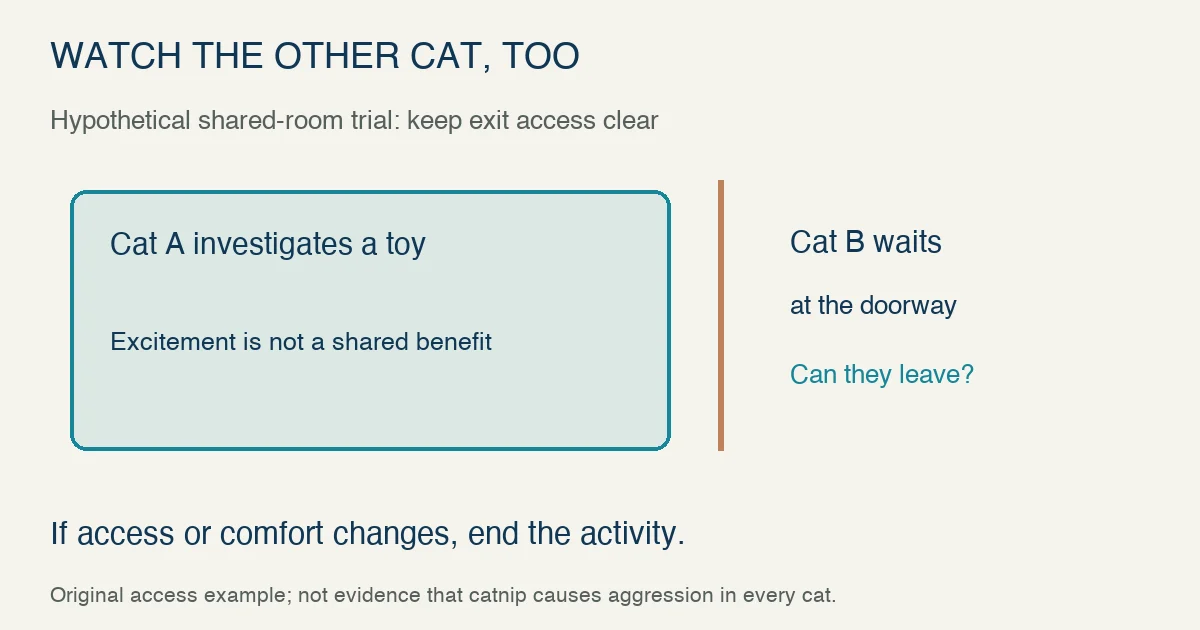
A hypothetical example: one cat rolls with a toy while a second cat waits in the doorway. That is not evidence both cats enjoy the session. If the first cat then blocks the doorway or guards the toy, the second cat's ability to leave and reach normal resources matters more than keeping the game going.
Offer individual opportunities in familiar spaces with clear exit routes when you can supervise. Avoid making one scented object the focus of a shared feeding or resting area. If competition starts, separate the activity rather than adding more scent to the same location. This is an access-management example, not a claim that catnip causes aggression in every household. Use the multi-cat resource guide to check ongoing routes and separate resources.
If the cat eats it or becomes unwell
Remove further access and keep the package or a photograph of the label. Note the material or product, the estimated amount if you actually know it, the time and any changes such as vomiting, diarrhea or unusual sedation. Do not invent an amount or assume every change is caused by catnip.
ASPCA advises contacting a local veterinarian or its Poison Control service as soon as possible for suspected potentially toxic ingestion. In the United States its number is (888) 426-4435; a consultation fee may apply. [2] Do not induce vomiting or give another substance as a home remedy. Let the veterinary team advise what the actual exposure requires.
Do not add catnip to food to solve poor appetite, or use it to conceal a broader illness. If the reason for trying it is a new change in eating, activity or behavior, discuss that change with your veterinarian. Your next useful action may be recording the concern, rather than buying another enrichment product.
This page is an AI-assisted practical synthesis, not veterinary-reviewed advice or a product test. The illustration is an original hypothetical access example. Sources disagree on broad safety wording; that uncertainty is preserved rather than replaced with a blanket reassurance.